BCBR
Writing a research concept paper
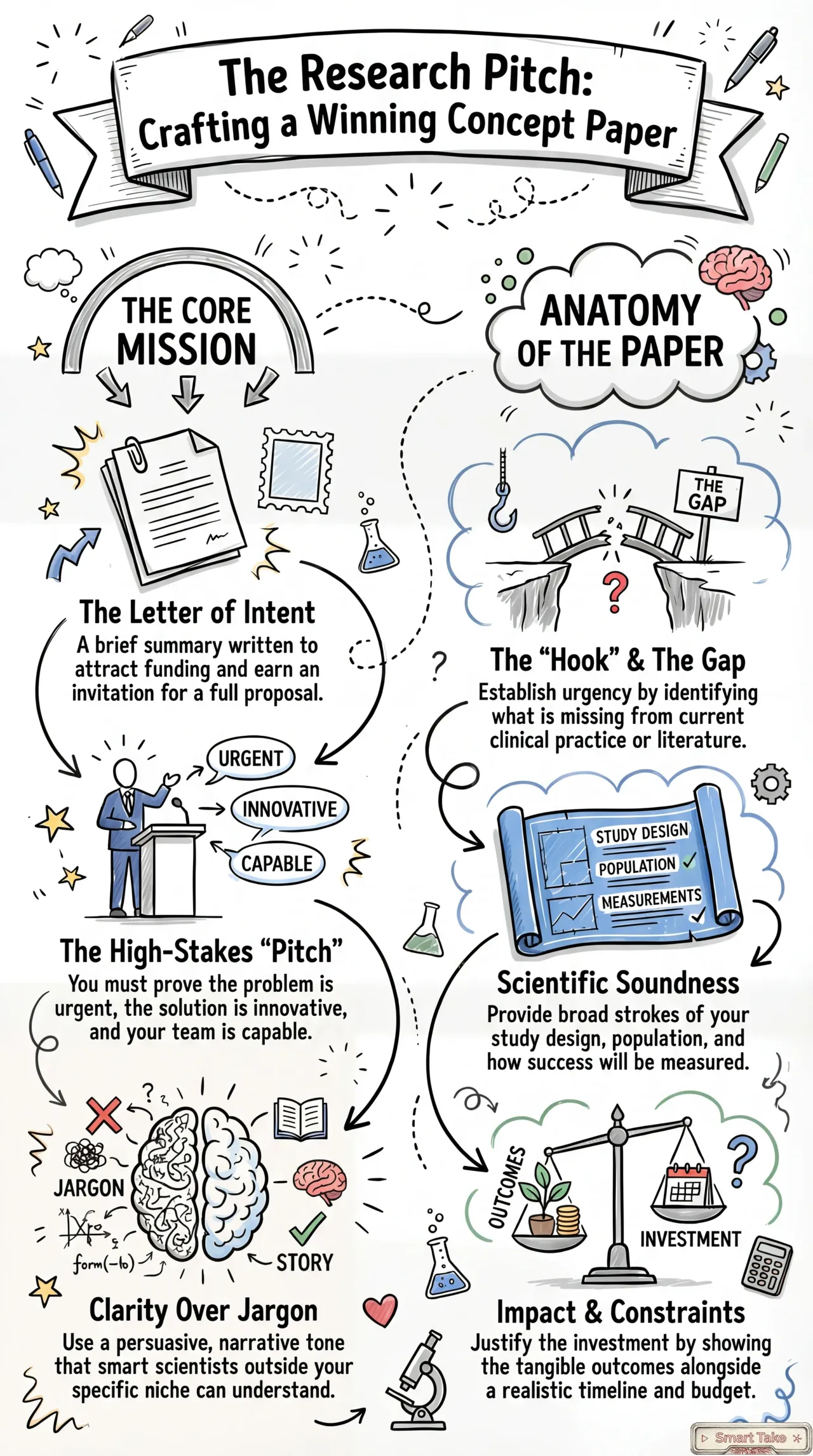
A concept paper, also known as a Letter of Intent or White Paper, is a concise 2-to-3-page pitch designed to secure research funding from agencies like the ICMR or NIH. It serves as a preliminary hurdle to filter high-potential ideas before inviting full proposals. The primary goal is to convince reviewers of a project's urgency, innovation, and feasibility by highlighting a critical gap in knowledge or practice and offering a scientifically sound solution.
Key points
- Purpose: Acts as a 'pitch' to attract funding and justify the feasibility of a research idea.
- Length: Typically a brief 2-to-3-page summary rather than a full protocol.
- Core Objective: To prove the problem is urgent, the solution is innovative, and the team is capable.
- Strategic Alignment: Must align clearly with the specific mission of the funding agency.
- Decision Tool: Funding agencies use it to decide whether to invite a researcher for a full proposal submission.
- Tone: Should be persuasive and narrative-driven, favoring clarity over dense technical jargon.
1. Definition and Synonyms
- Concept Paper: A brief summary of a research project written to attract funding.
- Also known as:
- Letter of Intent (LOI)
- Pre-proposal
- White Paper
2. Structural Elements
- A. Title
- Must be concise, descriptive, and memorable.
- Should immediately grab attention and hint at the problem/intervention.
- B. Introduction / The 'Hook' (Problem Statement)
- Establishes urgency and current relevance of the health problem.
- Identifies the 'Gap': What is missing in current literature or clinical practice?
- Alignment: Explicitly links the project to the funding agency’s mission.
- C. Objectives and Hypotheses
- Defines exactly what the project will achieve.
- Structure: One primary objective and 2-3 secondary objectives.
- Requirements: Must be specific, measurable, and state the central hypothesis clearly.
- D. Methodology (Brief)
- Focuses on scientific soundness and feasibility (broad strokes only).
- Study Design: (e.g., RCT, Retrospective Cohort).
- Population: Subject description and estimated sample size.
- Intervention: Description of what will be done.
- Data Analysis: Brief mention of success metrics.
- E. Expected Outcomes and Impact
- Answers the 'So What?' question.
- Describes tangible changes: clinical guideline updates, cost savings, or improved survival rates.
- F. Estimated Timeline and Budget
- Proves understanding of practical constraints.
- Includes rough estimates for project duration (e.g., 24 months) and total ballpark costs.
3. Practical Success Tips
- Clarity: Avoid excessive jargon; write for intelligent scientists who may not be niche experts.
- Strict Compliance: Adhere strictly to agency formatting (font size, page limits) to avoid immediate rejection.
- Persuasive Writing: Use a narrative arc to tell a story where the researcher is the solution to a pressing problem.