BCBR
Topic 16 · Principles of data collection
Principles of data collection
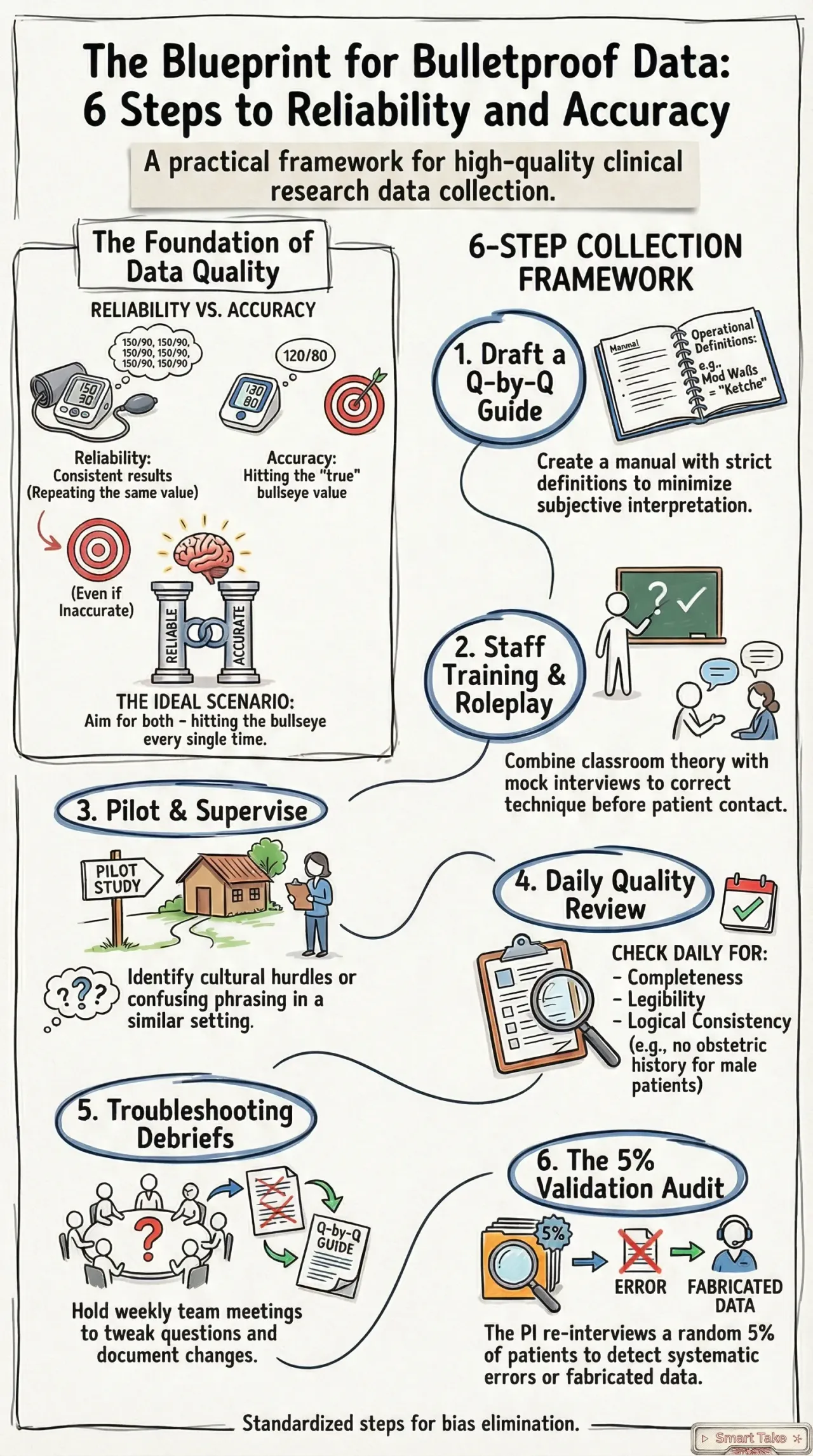
Effective data collection in biomedical research is grounded in the dual pillars of Reliability and Accuracy. High-quality research requires minimizing error through systematic processes, including the development of standardized Question-by-Question (Q-by-Q) guides, rigorous staff training, and pilot testing. Data quality is maintained through daily supervision, internal consistency checks, and a formal validation audit (typically 5% of the sample) to ensure the integrity and reproducibility of the study findings.
Key points
- Reliability: Consistency and reproducibility of measurements.
- Accuracy: Proximity of the measured value to the true value.
- Q-by-Q Guide: Essential document to minimize inter-observer variation by providing operational definitions.
- Training: Includes classroom sessions and role-playing to standardize data collection techniques.
- Pilot Study: Pre-testing the questionnaire in a similar setting to identify field challenges.
- Daily Review: Supervisors must check forms for completeness, readability, and internal consistency every day.
- Data Validation (Audit): Re-interviewing a 5% random sub-sample to detect errors or fabrication.
I. Two Pillars of Data Quality
- Reliability: The ability of a tool or observer to yield the same results repeatedly under the same conditions (Consistency).
- Accuracy: The degree to acknowledge how close a measurement is to the actual true value (Validity).
II. The Four Scenarios of Data Quality
- Reliable and Accurate: The ideal state where data is both consistent and reflects the truth.
- Reliable but Not Accurate: Results are consistent but systematically wrong (indicates Systematic Error or Bias).
- Accurate but Not Reliable: The average might be near the truth, but individual measurements are highly scattered (High Variance).
- Neither Reliable nor Accurate: Data is inconsistent and far from the truth (Worst-case scenario).
III. The Six Steps of Highly Effective Data Collection
Step 1: Drafting a Question-by-Question (Q-by-Q) Guide
- Purpose: Minimizes inter-observer variation among different investigators.
- Contents:
- Operational definitions for every term.
- Instructions on skip patterns.
- Specific probes to use for clarification.
- Emphasis areas for the interview.
Step 2: Training the Staff
- Selection: Matching skills to the study (e.g., clinical fluency for trials vs. local language for community studies).
- Classroom Session: Explaining study objectives, methodology, and the Q-by-Q guide.
- Role-Playing: Mock interviews to correct technique before actual patient contact.
Step 3: Initiating Data Collection & On-Site Quality
- Piloting: Testing in a similar (but not the actual) study site to find cultural or linguistic flaws.
- Supportive Supervision: Establishing a chain of command and ensuring the PI is reachable for clinical doubts.
- Time Management: Prioritizing accuracy over speed; avoiding unrealistic daily quotas.
Step 4: Review for Quality and Completeness
- Frequency: Must occur daily.
- Checklist:
- Completeness: Ensuring no blanks/missing data (which reduce statistical power).
- Readability: Ensuring handwriting and clinical narratives are legible.
- Internal Consistency: Ensuring answers logically align with one another.
Step 5: Debriefing to Troubleshoot
- Periodic meetings to discuss field difficulties and patient refusals.
- Updating the Q-by-Q guide if protocols are tweaked and informing the entire team.
Step 6: Data Validation (The Audit)
- Method: The PI or an independent auditor selects a random 5% sub-sample of the population.
- Action: Conducts a second independent interview with the same patients.
- Purpose: Detects discrepancies, systematic errors, or data fabrication (falsified forms).