BCBR
Topic 12 · Sample size and power
Power, alpha and beta errors
This module outlines the fundamental statistical principles of hypothesis testing required for medical research and the BCBR exam. It focuses on the definitions and clinical implications of the Null and Alternate Hypotheses, the categorization of Type 1 (Alpha) and Type 2 (Beta) errors, and the calculation of statistical power. The text emphasizes that the reliability of a study's findings depends on its ability to minimize these errors through appropriate sample size determination and understanding the effect size of the association being studied.
Key points
- Null Hypothesis Assumes no association between exposure and outcome.
- Alternate Hypothesis Assumes a definitive association exists.
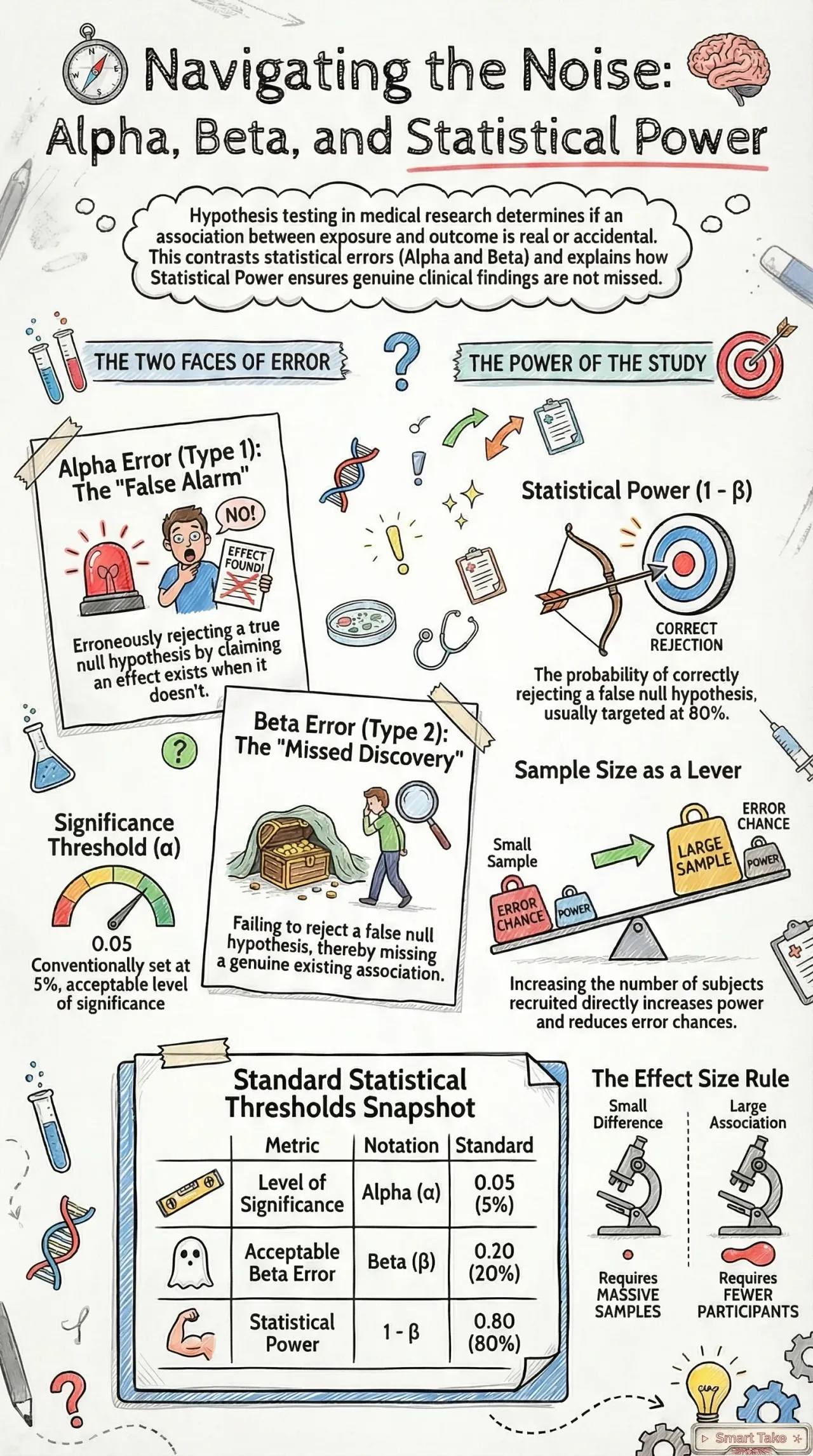
- Type 1 Error (Alpha): Falsely rejecting a true null hypothesis (False Positive).
- Type 2 Error (Beta): Failing to reject a false null hypothesis (False Negative).
- Confidence Level: Represented as ; usually set at 95%.
- Statistical Power: Represented as ; usually set at 80%.
- Sample Size Relationship: Larger sample sizes decrease Alpha error and increase Statistical Power.
- Effect Size: Larger effect sizes require smaller sample sizes to achieve the same power.
1. The Hypotheses
- Null Hypothesis The default position that there is zero association or no difference between the groups being studied.
- Alternate Hypothesis The position that a relationship exists. It can be:
- Single-tailed: Predicting the direction of the effect.
- Two-sided: Predicting a difference exists without specifying direction.
- Application: Essential for analytical studies (case-control, cohort); not used in descriptive studies.
2. Type 1 Error (Alpha Error)
- Definition: Erroneously rejecting when it is actually true (False Positive).
- Probability (Alpha The risk the researcher is willing to take of being wrong.
- Level of Significance Conventionally set at 5% (0.05).
- Confidence Level The probability that the population parameter falls within specified limits (usually 95%).
- Impact of Sample Size: Inversely proportional; as sample size increases, Alpha error risk decreases.
3. Type 2 Error (Beta Error)
- Definition: Failing to reject when it is actually false (False Negative).
- Clinical Meaning: Missing a genuine association that truly exists in the population.
- Probability (Beta Conventionally set at 0.20 (20%) in most analytical designs.
4. Statistical Power
- Formula: .
- Definition: The probability of correctly rejecting the null hypothesis when it is false (identifying a true effect).
- Acceptable Standard: Usually 80% (when is 0.20).
- Relationship with Sample Size: Directly proportional; increasing subjects increases the study's power.
- Post-Hoc Power Analysis: Performed after a study is completed to determine if a non-significant result was due to an inadequate sample size.
5. Effect Size
- Definition: The true strength of the association (e.g., Relative Risk or Odds Ratio).
- Large Effect Size: Requires a smaller sample size to reach adequate power.
- Small Effect Size: Requires a massive sample size to detect minor variances accurately.