BCBR
Topic 06 · Analytical study designs
Case-control studies
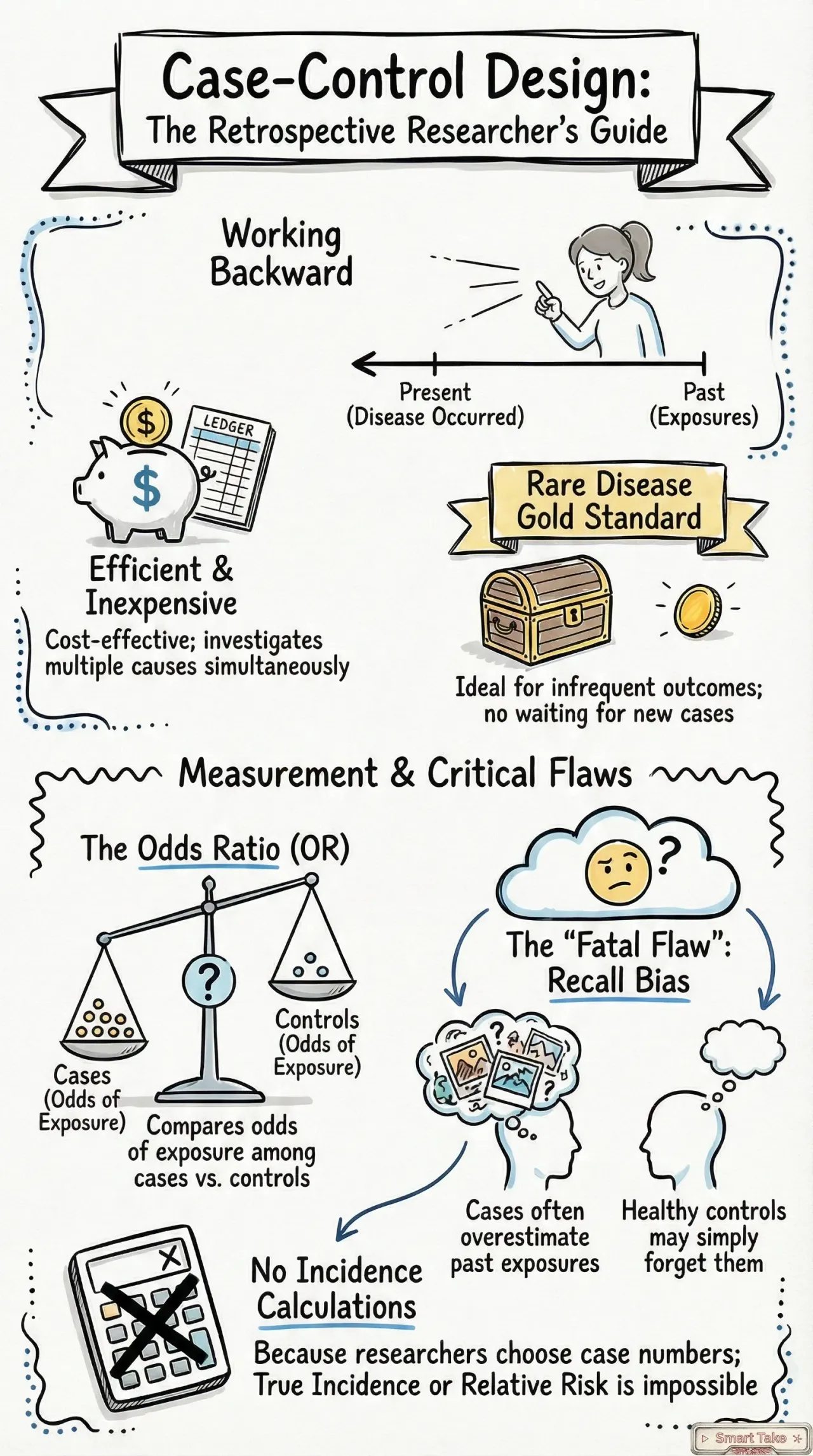
Analytical studies, specifically the Case-Control design, mark a shift from descriptive observation to hypothesis testing regarding cause-and-effect relationships. This design is characterized by its retrospective nature, starting with the known outcome (disease) and looking backward to assess exposure. By comparing a group with the disease (Cases) to a group without it (Controls), researchers can identify risk factors. It is the most efficient design for investigating rare diseases and conditions with long induction periods, though it is uniquely susceptible to certain systematic errors like recall bias.
Key points
- Purpose: To test hypotheses and determine associations between exposures and outcomes.
- Directionality: Retrospective (starts with the outcome and moves backward to the exposure).
- Essential Requirement: Must have a comparison group (Controls).
- Primary Metric: Odds Ratio (OR) is used because incidence cannot be calculated.
- Best Use Case: Rare diseases and multiple potential etiologies for a single disease.
- Major Limitation: Highly prone to Recall Bias and selection bias.
- Interpretation: OR > 1 indicates a risk factor; OR < 1 indicates a protective factor; OR = 1 indicates no association.
1. Analytical Research Overview
- Goal: To establish a relationship between a suspected cause and an effect.
- Requirement: Always involves a comparison group to validate findings.
- Primary Observational Designs: Case-Control and Cohort studies.
2. Case-Control Architecture
- Retrospective Nature: The investigator begins the study after the disease has already occurred.
- Step-by-Step Methodology:
- Step 1 (Select Cases): Identify a group of individuals who already have the specific disease or outcome.
- Step 2 (Select Controls): Identify a highly comparable group of individuals who do not have the disease.
- Step 3 (Exposure Assessment): Look backward in time using medical records, interviews, or registries to determine the proportion of exposure in both groups.
3. Indications for Use
- Rare Diseases: Ideal because researchers don't have to wait for the disease to manifest naturally in a large population.
- Long Latency: Useful for diseases that take years to develop.
- Efficiency: Relatively inexpensive and requires less time compared to prospective studies.
- Multifactorial Etiology: Excellent for investigating multiple different risk factors for a single disease.
4. Statistical Measure: The Odds Ratio (OR)
- Why OR?: Researchers artificially set the number of cases and controls; therefore, the true incidence (new cases in a population at risk) cannot be determined.
- Relative Risk (RR): Cannot be calculated in Case-Control studies.
- Definition: The ratio of the odds of exposure among cases to the odds of exposure among controls.
- Mathematical Expression:
- Result Interpretation:
- OR = 1: No association between exposure and disease.
- OR > 1: Positive association (Exposure is a risk factor).
- OR < 1: Negative association (Exposure is a protective factor).
5. Critical Limitations
- Recall Bias: The most frequently tested flaw. Cases (the ill) are more likely to remember and over-report past exposures than healthy controls.
- Selection Bias: Difficulty in ensuring the control group is truly representative of the population that produced the cases.
- Temporal Ambiguity: Sometimes difficult to prove that the exposure definitely preceded the disease.