BCBR
Topic 06 · Analytical study designs
Cohort studies
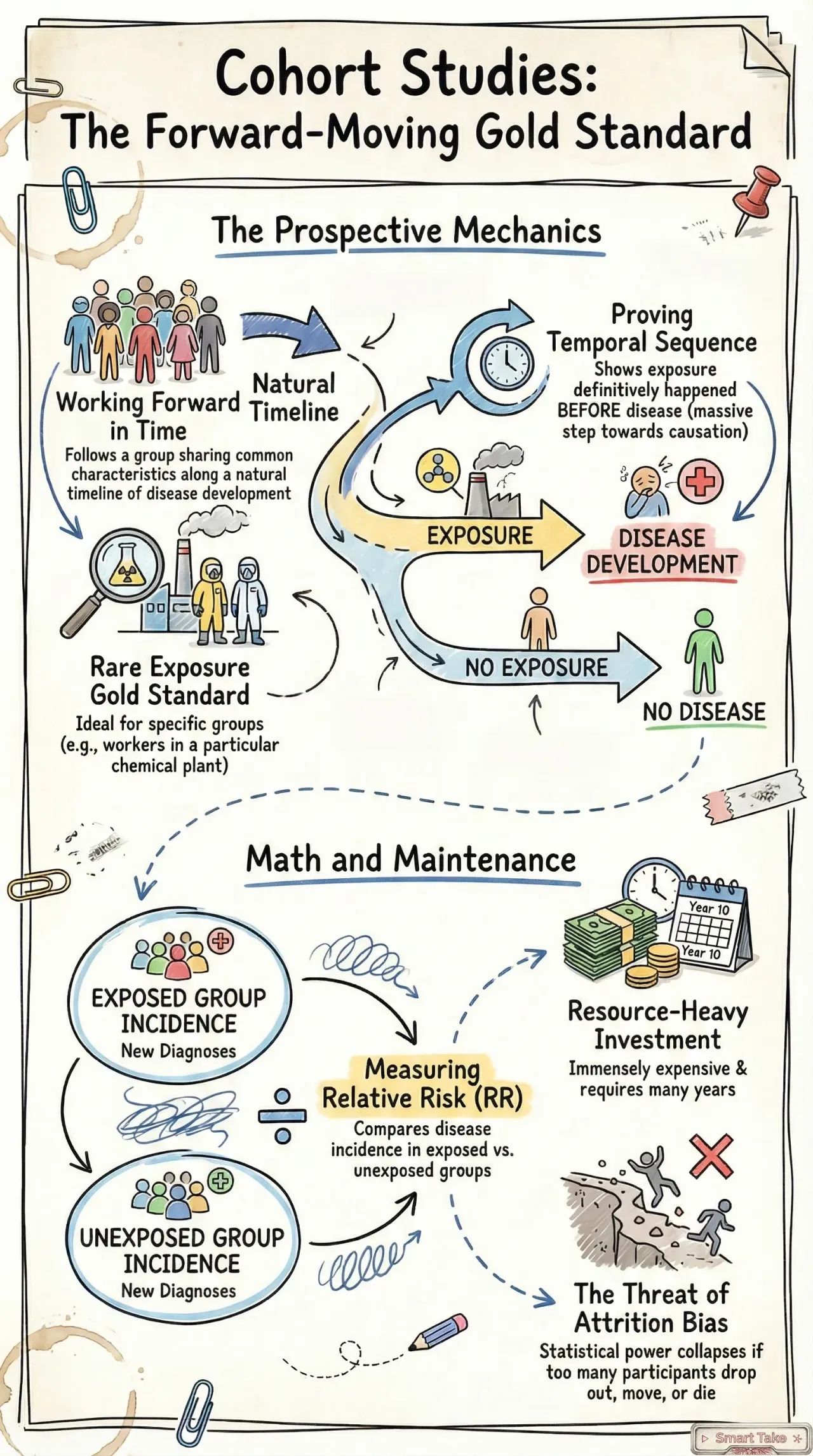
Cohort studies are a cornerstone of analytical observational research, characterized by a 'working forward' architecture that follows individuals from exposure to outcome. Unlike case-control studies, cohort designs begin with a disease-free population, categorizing them into exposed and unexposed groups to observe the natural development of a disease over time. This prospective nature allows for the direct calculation of incidence and establishes a clear temporal sequence, making it a powerful tool for investigating causal relationships, particularly in the context of rare exposures. While highly robust, the design is resource-intensive and prone to attrition bias due to the long follow-up periods required.
Key points
- Directionality: Always prospective or 'working forward' from exposure to outcome.
- Study Population: Starts with a defined group (cohort) that is initially free of the disease/outcome being studied.
- Primary Metric: Uses Relative Risk (RR) or Risk Ratio, which is based on the incidence of the disease.
- Temporal Sequence: Provides strong evidence of causation because exposure is documented before the disease occurs.
- Best Use Case: Ideal for studying rare exposures (e.g., occupational hazards, specific environmental leaks).
- Major Weakness: Susceptible to Loss to Follow-up (Attrition Bias) and requires significant time and financial resources.
1. The Cohort Architecture
- Definition: A cohort is a group of individuals sharing a common characteristic (e.g., birth year, occupation).
- Selection Process:
- Step 1: Select a healthy population (must be free of the outcome of interest at the start).
- Step 2: Categorize the population into 'Exposed' and 'Unexposed' groups based on natural history/choices.
- Step 3: Longitudinal follow-up over a designated period (years or decades).
- Step 4: Observe and record the development of the disease/outcome in both groups.
2. Indications for Cohort Studies
- Rare Exposures: The gold standard for investigating rare or specific exposures (e.g., workers in a chemical plant).
- Causality: Essential for establishing temporal sequencing (Proof that exposure preceded the disease).
- Multiple Outcomes: Can be used to study multiple outcomes resulting from a single exposure.
3. Measuring Association: Relative Risk (RR)
- Incidence Calculation: Because the denominator (the population at risk) is known and followed over time, true incidence can be calculated.
- Formula:
- Interpretation:
- RR = 1: No association between exposure and disease.
- RR > 1: Increased risk in the exposed group (e.g., RR = 5 means the exposed group is 5 times more likely to develop the disease).
- RR < 1: The exposure may be a protective factor.
4. Limitations and Challenges
- Resource Intensity: Requires massive financial investment and long timeframes.
- Attrition Bias (Loss to Follow-up): The most significant threat to validity. Participants may:
- Move away.
- Withdraw consent.
- Die from unrelated causes.
- Statistical Impact: Significant dropouts lead to a loss of statistical power and potential bias if those who drop out differ from those who remain.
- Inefficiency for Rare Diseases: Not suitable for rare diseases as the cohort would need to be massive to observe enough cases.