BCBR
Topic 20 · Conducting clinical trials
Clinical trial phases
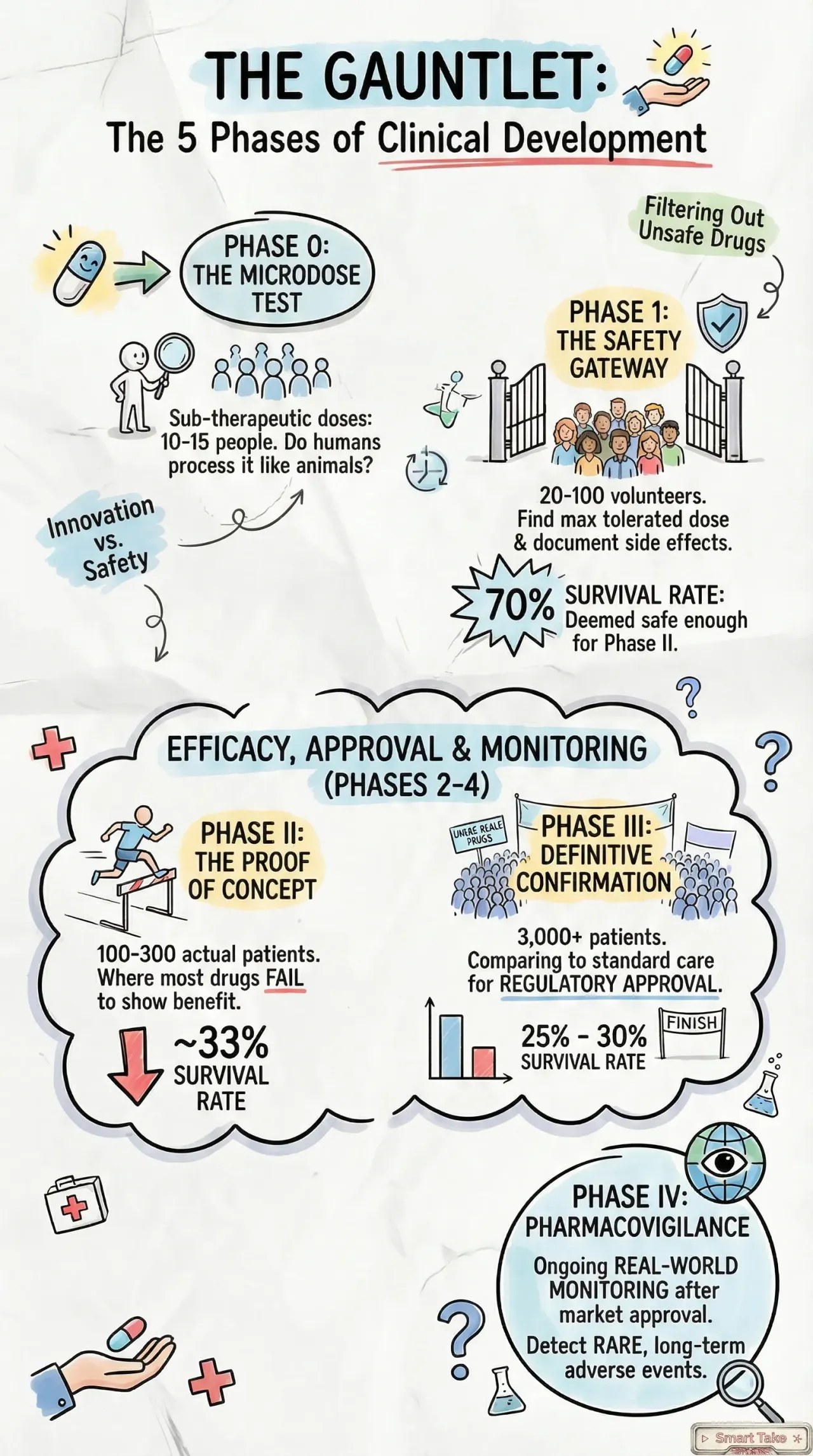
Clinical development is a systematic, sequential process required to evaluate the safety and efficacy of new medical interventions (drugs, biologics, or devices) before public use. This process transitions from pre-clinical lab and animal studies into five distinct human trial phases (Phase 0 to IV). Each phase has specific objectives, ranging from initial human microdosing and safety assessments to large-scale efficacy confirmation and long-scale post-marketing surveillance. This rigorous framework ensures that only treatments with a favorable risk-benefit ratio reach the healthcare market.
Key points
- Phase 0 (Microdosing): Preliminary human study to track pharmacokinetics using sub-therapeutic doses in a tiny cohort.
- Phase I (Safety): First-in-human trials focused on determining the Maximum Tolerated Dose (MTD) and safety profiles, usually in healthy volunteers.
- Phase II (Proof of Concept): Initial evaluation of therapeutic efficacy and optimal dosing in a small group of patients with the target disease.
- Phase III (Definitive Confirmation): Large-scale, multi-center trials comparing the new drug against the standard of care to confirm efficacy and monitor side effects.
- Phase IV (Post-Marketing): Continuous real-world monitoring (pharmacovigilance) after market approval to detect rare or long-term adverse events.
Phase 0: Pharmacodynamics and Pharmacokinetics
- Primary Goal: To bridge the gap between animal models and human response early.
- Methodology: Uses microdoses (sub-therapeutic) that do not produce a clinical effect.
- Subjects: 10 to 15 healthy volunteers.
- Duration: Very short (days).
- Core Focus: Human metabolism (Pharmacokinetics) and drug action at the cellular level (Pharmacodynamics).
Phase I: First in Human (Safety)
- Primary Goal: Safety assessment and dosage range finding.
- Key Parameters: Identifying Maximum Tolerated Dose (MTD), absorption, metabolism, and acute side effects.
- Subjects: 20 to 100 healthy volunteers.
- Exception: For toxic drugs like chemotherapy, end-stage patients are used instead of healthy volunteers.
- Duration: Several months.
- Success Rate: Approximately 70% move to the next phase.
Phase II: Proof of Concept (Efficacy)
- Primary Goal: To see if the drug works (Efficacy) and refine the dose.
- Subjects: 100 to 300 patients who have the target disease.
- Duration: Several months to 2 years.
- Success Rate: Approximately 33% (highest failure rate often occurs here due to lack of clinical benefit).
Phase III: Definitive Confirmation
- Primary Goal: Establish comparative efficacy and monitor long-term safety.
- Methodology: Comparison against a placebo or the current 'Standard of Care'.
- Subjects: 300 to 3,000+ patients in diverse populations (multi-center/international).
- Duration: 1 to 4 years.
- Outcome: Success leads to the submission of a New Drug Application (NDA) to regulatory bodies like the FDA or CDSCO.
Phase IV: Post-Marketing Surveillance
- Primary Goal: Pharmacovigilance (real-world safety monitoring).
- Subjects: General population (hundreds of thousands of users).
- Duration: Ongoing indefinitely after market approval.
- Significance: Detects rare side effects or long-term complications not caught in shorter trials; can lead to 'Black Box Warnings' or drug recalls.