BCBR
Topic 20 · Conducting clinical trials
Good Clinical Practice (GCP)
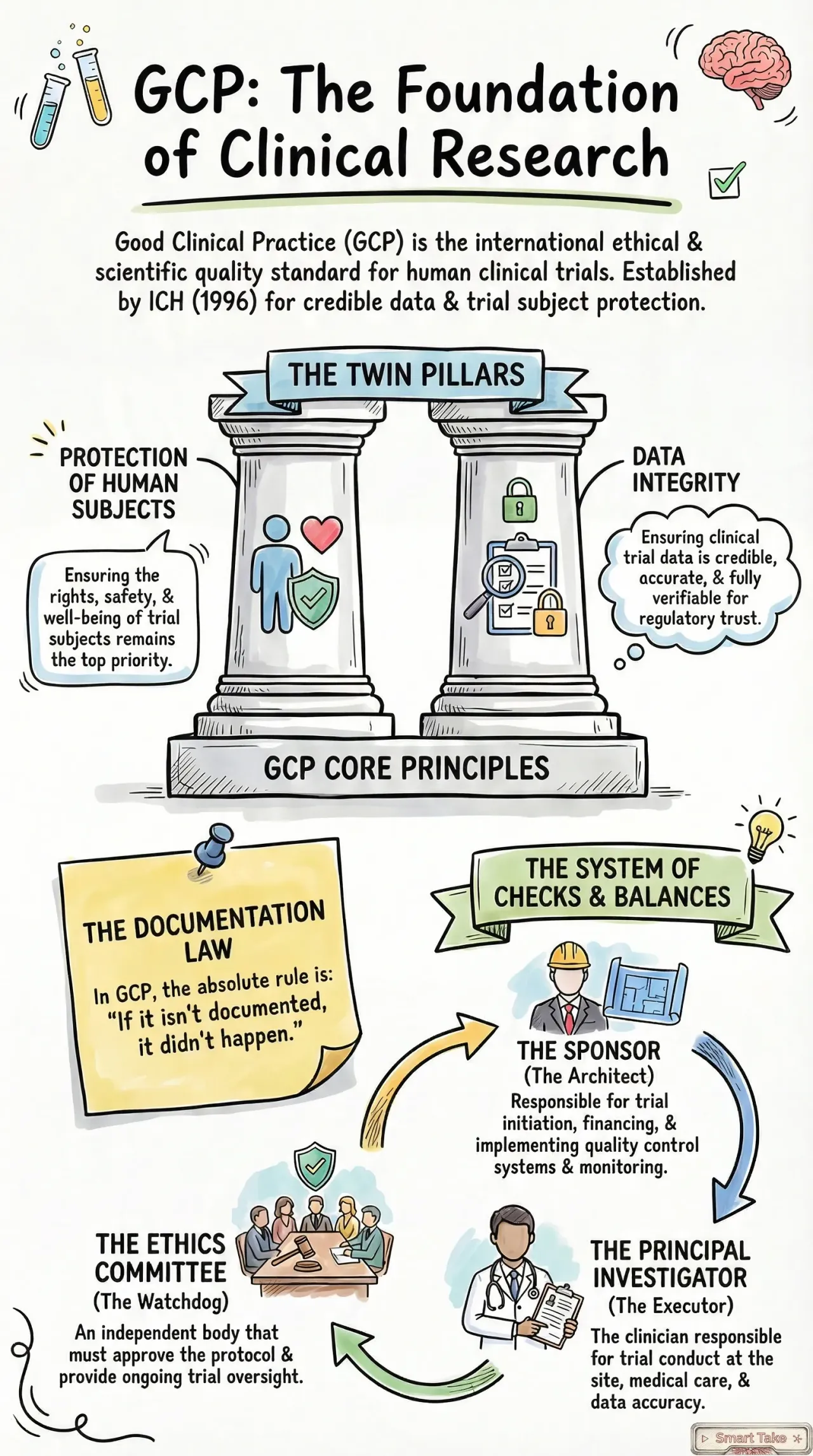
Good Clinical Practice (GCP) is an international ethical and scientific quality standard for the design, conduct, recording, and reporting of clinical trials involving human subjects. Established by the International Council for Harmonisation (ICH) in 1996, these guidelines provide a unified global framework that ensures the protection of participants' rights and the integrity of clinical trial data. The standards are rooted in the Declaration of Helsinki, prioritizing the well-being of the individual over the interests of science or society. Adherence to GCP ensures that clinical data are credible and that the results are verifiable, forming the basis for regulatory approval of new medical interventions.
Key points
- GCP is a dual-purpose standard: Protection of human subjects and ensuring data integrity.
- Based on 13 core principles, including ethics-first, risk/benefit assessment, and informed consent.
- Requires strict protocol adherence and approval by an Institutional Ethics Committee (IEC).
- Roles are clearly defined between the Sponsor (oversight/funding), Investigator (site conduct), and Ethics Committee (subject protection).
- The fundamental rule of GCP documentation is: "If it isn't documented, it didn't happen."
-
Definition and Origin
- GCP is the international standard for ethical and scientific quality in human research.
- ICH-GCP (1996): Published by the International Council for Harmonisation to unify standards across the US, Europe, and Japan.
- Two Pillars:
- Subject Protection: Rights, safety, and well-being (based on Declaration of Helsinki).
- Data Integrity: Credibility, accuracy, and verifiability of trial data.
-
13 Core Principles of GCP
- Ethical Conduct: Follow Declaration of Helsinki principles.
- Risk vs. Benefit: Benefits must justify the risks before initiating a trial.
- Subject Priority: The rights and safety of subjects outweigh the interests of science.
- Product Information: Non-clinical and clinical information must support the trial.
- Scientific Protocol: Trials must follow a clear, detailed, and approved protocol.
- Ethics Approval: Must receive prior approval from an Institutional Ethics Committee (IEC) or Institutional Review Board (IRB).
- Medical Care: Responsibility of a qualified physician/dentist.
- Qualified Personnel: Everyone involved must be qualified by education, training, and experience.
- Informed Consent: Must be freely given by every subject prior to participation.
- Data Records: Information must be recorded, handled, and stored for accurate reporting and verification.
- Confidentiality: Privacy of subjects must be protected according to regulatory requirements.
- GMP Compliance: Investigational products must be manufactured and handled according to Good Manufacturing Practice (GMP).
- Quality Systems: Systems with procedures that assureทุก aspect of the trial quality must be implemented.
-
Roles and Responsibilities
- 1. The Sponsor (The Entity)
- Responsibility: Initiation, management, and financing (e.g., Pharma companies, NIH, ICMR).
- Must implement Quality Assurance (QA) and Standard Operating Procedures (SOPs).
- Appoints Monitors/CRAs to audit sites and ensure protocol compliance.
- Handles safety reporting of severe, unexpected adverse drug reactions to authorities.
- 2. The Principal Investigator (PI) (The Clinician)
- Responsibility: Actual conduct of the trial at the site.
- Must provide medical care for any adverse events.
- Must ensure adequate resources (time, staff, facilities).
- Strictly adheres to the protocol; deviations allowed only to eliminate immediate hazards.
- Responsible for the accuracy of Case Report Forms (CRFs).
- 3. The Ethics Committee (IEC/IRB) (The Guardian)
- Independent body ensuring subject protection.
- Conducts prior review of protocol, consent forms, and investigator brochures.
- Provides ongoing oversight (review at least once per year).
- 1. The Sponsor (The Entity)
-
The Golden Rule of GCP
- "If it isn't documented, it didn't happen."
- Every action (pill dispensed, blood drawn, complaint) must be recorded to ensure the public can trust medicine safety and efficacy.