BCBR
Data entry, coding and cleaning
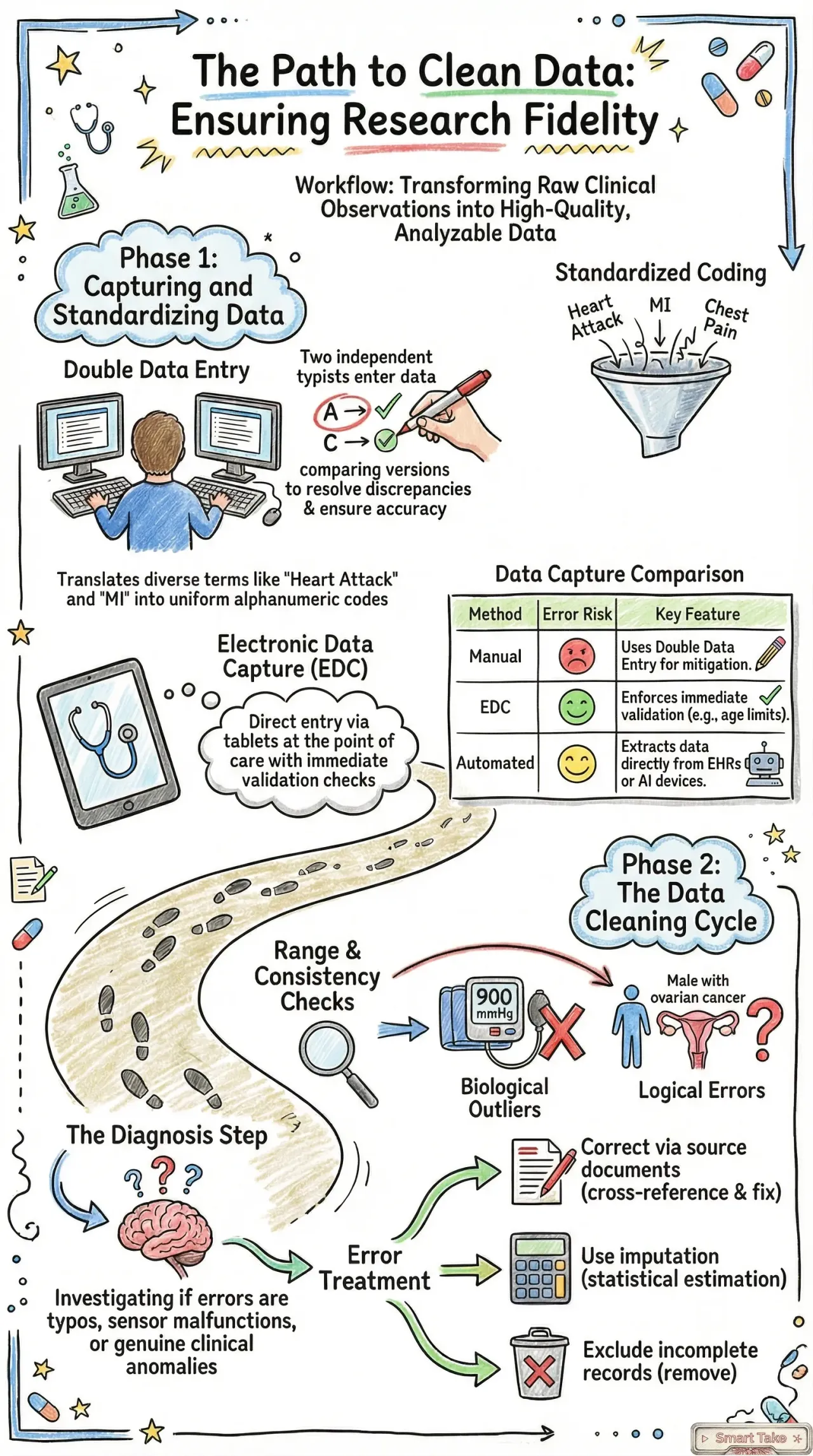
Data Entry, Coding, and Cleaning represent the foundational phase of biomedical research where raw clinical information is transformed into a structured, high-quality dataset suitable for statistical analysis. This process ensures the 'fidelity' of data, moving from the collection of source documents (like Case Report Forms) to the application of standardized medical dictionaries (ICD, MedDRA) and the rigorous detection and correction of errors. In the context of the Basic Course in Biomedical Research (BCBR), these steps are critical to prevent 'Garbage In, Garbage Out' scenarios, ensuring that research conclusions are based on accurate, consistent, and logically sound data.
Key points
- Data Entry: The transfer of data from source documents (CRFs) to a computerized database.
- Double Data Entry: A gold-standard technique involving two independent entries to minimize human error through comparison.
- Electronic Data Capture (EDC): Direct digital entry at the point of care with built-in validation checks.
- Coding: Translating qualitative/textual clinical data into standardized alphanumeric codes for uniform analysis.
- Standard Dictionaries: Essential tools like ICD (diagnoses) and MedDRA (adverse events) provide a common language.
- Data Cleaning: The structured process of screening, diagnosing, and treating data inaccuracies before analysis.
- Logical Consistency: Ensuring related data points (e.g., gender and specific diseases) are biologically and clinically plausible.
1. Data Entry Methods
- Manual Data Entry:
- Human operators type data from paper CRFs.
- High risk of human error.
- Double Data Entry: Two people enter the same data; a computer flags discrepancies for resolution.
- Electronic Data Capture (EDC):
- Data entered directly into tablets/computers.
- Features real-time validation (e.g., preventing impossible ages or dates).
- Automated Data Capture:
- Direct extraction from Electronic Health Records (EHRs) or diagnostic devices (e.g., AI apps).
2. Data Coding
- Definition: Converting qualitative descriptions (e.g., 'Heart Attack') into uniform codes (e.g., 'MI').
- Purpose: Enables statistical software to group identical clinical entities that were recorded using different terminology.
- Standardized Dictionaries:
- ICD (International Classification of Diseases): Standard for global diagnoses.
- MedDRA (Medical Dictionary for Regulatory Activities): Standard for adverse events in clinical trials.
- SNOMED CT: Comprehensive clinical terminology system.
3. Data Cleaning Process
- Three Core Steps:
- Screening: Identifying missing data, outliers, or unreadable entries.
- Diagnosis: Investigating the source of the error (typo vs. clinical anomaly).
- Treatment: Correcting via source documents, marking as missing, or excluding the record.
- Error Types Handled:
- Range Checks: Identifying values outside biological possibility (e.g., Systolic BP of 900).
- Consistency/Logical Checks: Identifying contradictions (e.g., 'Male' patient with 'Ovarian Cancer').
- Missing Values: Handling empty fields through substitution, imputation, or deletion based on the nature of the missingness (MCAR, MAR, MNAR).
4. Critical Concept
- 'Garbage In, Garbage Out': The quality of statistical output is strictly dependent on the quality of the input data. Errors at the entry or coding stage propagate through the entire research cycle.