BCBR
Data dictionaries and secure data storage
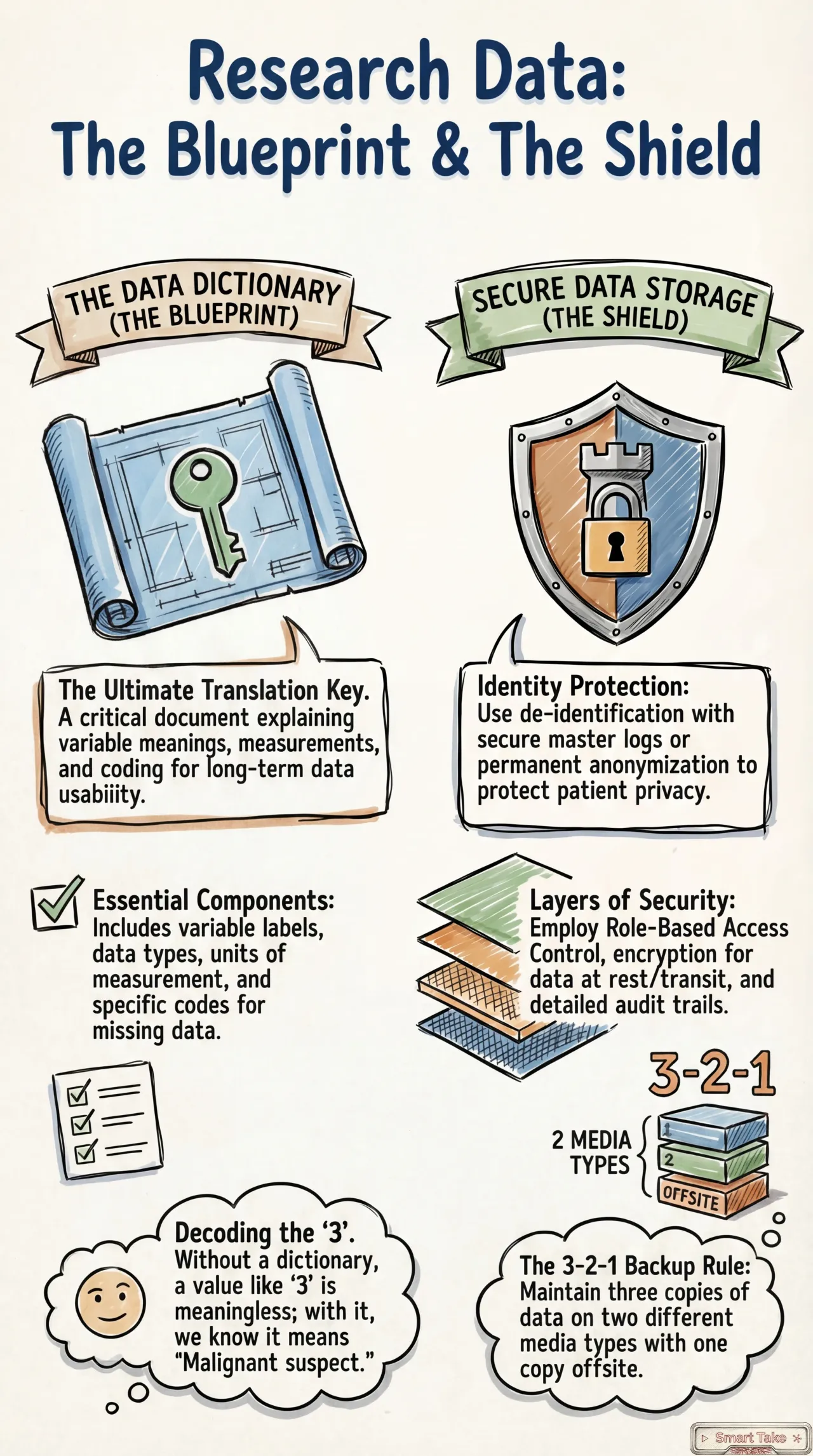
This module covers the dual pillars of data integrity and protection in biomedical research: Data Dictionaries and Secure Data Storage. A Data Dictionary serves as the essential 'blueprint' or codebook that defines the structure, variables, and coding of a dataset to ensure reproducibility and clarity. Complementing this, Secure Data Storage protocols, including anonymization, encryption, access control, and audit trails, are mandatory legal and ethical requirements designed to protect sensitive Protected Health Information (PHI) and maintain public trust throughout the research lifecycle.
Key points
- Data Dictionary (Codebook): A comprehensive document describing data structure, variable meanings, measurements, and coding schemes.
- Variable Identification: Includes short names (e.g.,
SYS_BP), detailed labels, data types (numeric/string), and measurement units. - Coding Schemes: Essential for interpreting categorical data (e.g., 0 = Male, 1 = Female).
- PHI Protection: Strict mandates for handling sensitive medical, genomic, and personal identifiers.
- De-identification vs. Anonymization: De-identification uses Study IDs with a separate master log; anonymization permanently removes all links to identity.
- Data Security Layers: Implementation of encryption (at rest and in transit), Role-Based Access Control (RBAC), and automated backups.
- Audit Trails: Necessary for GCP compliance, logging every access and modification to the dataset.
1. The Data Dictionary (The 'Blueprint')
- Definition: A critical document accompanying a dataset that explains how data is measured and coded.
- Core Components:
- Variable Name: Short abbreviations used in software (e.g.,
AGE_YRS). - Variable Label: Full description (e.g., 'Age in years at enrollment').
- Data Type: Categorization of data (Continuous/Numeric, Categorical/String, or Date).
- Coding Scheme: Values assigned to categories (e.g., 1 = Normal, 2 = Benign).
- Units of Measurement: Physical units used (e.g., kg, mmHg, mg/dL).
- Missing Data Codes: Specific values clarifying why data is absent (e.g., 999 = N/A, 888 = Lost to follow-up).
- Variable Name: Short abbreviations used in software (e.g.,
2. Secure Data Storage Principles
- Anonymization and De-identification:
- De-identification: Direct identifiers are replaced with a unique Study ID; a master linking log is stored separately and securely.
- Anonymization: Identifiers are permanently destroyed; data cannot be traced back to the individual.
- Access Control (RBAC):
- Ensures data is only accessible to authorized personnel.
- Permissions are based on roles (e.g., clerk can only enter data; PI can export full datasets).
- Encryption Standards:
- Data at Rest: Encrypting data on servers, hard drives, or cloud storage to prevent unauthorized reading if hardware is stolen.
- Data in Transit: Using secure protocols (SSL/TLS) to protect data moving between sites and servers.
- Backups and Disaster Recovery:
- 3-2-1 Rule: 3 copies of data, 2 different media types, 1 copy stored offsite.
- Protects against server failure, ransomware, or natural disasters.
- Audit Trails:
- Mandatory for Good Clinical Practice (GCP) and FDA 21 CFR Part 11.
- Logs: Who accessed data, what was changed, timestamp, and previous values.
3. Importance in Research
- Usability: Ensures datasets remain understandable for future researchers.
- Reproducibility: Allows for consistent analysis over time.
- Compliance: Meets international legal/ethical regulations for protecting vulnerable populations.