BCBR
Topic 05 · Descriptive study designs
Case reports and case series
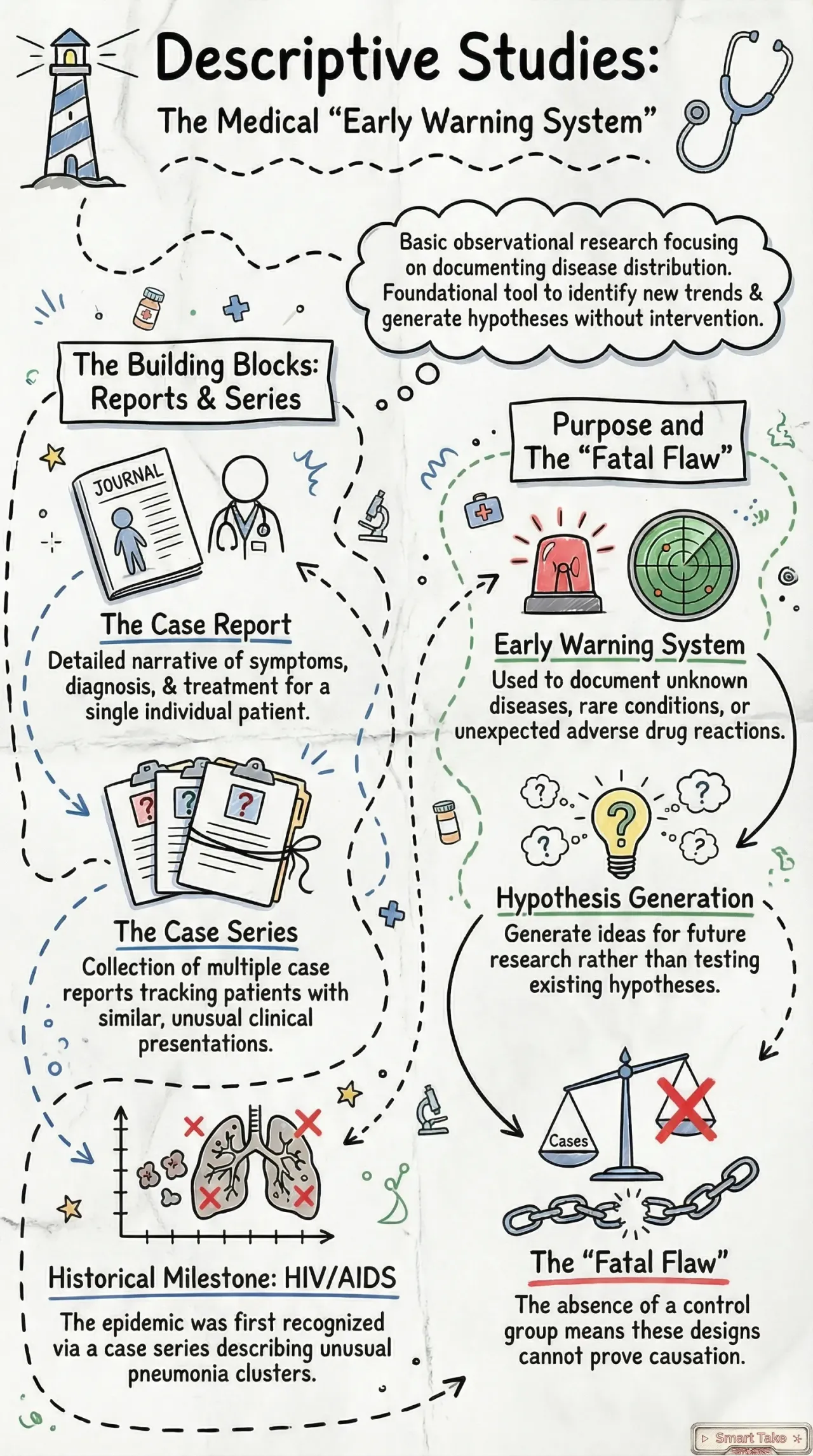
This topic focuses on the most fundamental forms of observational research: Case Reports and Case Series. These descriptive studies serve as the primary building blocks of clinical evidence by documenting the distribution of diseases in relation to person, place, and time. Unlike analytical or experimental studies, descriptive studies do not test pre-defined hypotheses; rather, they are hypothesis-generating tools. They provide a detailed narrative of clinical observations, serving as an early warning system for the medical community to identify rare conditions, new diseases, or adverse drug reactions. However, their utility is strictly limited by the absence of a control group, meaning they cannot establish a causal relationship between an exposure and an outcome.
Key points
- Foundational Research: Descriptive studies are the simplest form of observational research.
- Goal: To generate hypotheses, not test them.
- Variable Focus: Documents disease distribution based on person, place, and time.
- Case Report: A detailed narrative focusing on a single unique patient.
- Case Series: A collection of similar case reports over a short duration.
- Major Limitation: Lacks a control (comparison) group.
- Causality: Cannot prove cause-and-effect; only suggests potential associations.
1. Classification of Study Designs
- Observational Studies: The researcher observes and measures without intervention. Descriptive studies fall under this category.
- Experimental Studies: The researcher actively intervenes (e.g., Clinical Trials).
2. The Case Report
- Definition: A detailed clinical profile and narrative of a single individual patient.
- Components Included:
- Symptoms and clinical signs.
- Diagnostic procedures and results.
- Treatment protocols administered.
- Clinical follow-up and outcomes.
- Primary Utilities:
- Documenting previously unknown or emerging diseases.
- Reporting extremely rare medical conditions.
- Identifying unusual presentations of common diseases.
- Flagging unexpected adverse drug reactions (ADRs).
- Reporting the use of new diagnostic tools or technologies.
3. The Case Series
- Definition: A descriptive study consisting of a collection of individual case reports involving patients with similar or unusual clinical features.
- Timeline: Usually tracked over a relatively short period.
- Historical Significance: Essential for identifying epidemics (e.g., the 1980s HIV/AIDS epidemic began as a case series of Pneumocystis pneumonia and Kaposi's sarcoma).
4. Critical Limitations and Exam Essentials
- Absence of Control Group: This is the most significant flaw. There is no comparison group (healthy individuals or those without the condition).
- Statistical Limitation: Due to the lack of a comparison group, researchers cannot calculate measures of association or relative risk.
- Scientific Role: These studies occupy the bottom of the hierarchy of evidence for establishing causality. They serve as the starting point for more rigorous analytical designs (like Case-Control or Cohort studies).