BCBR
Topic 05 · Descriptive study designs
Cross-sectional and ecological studies
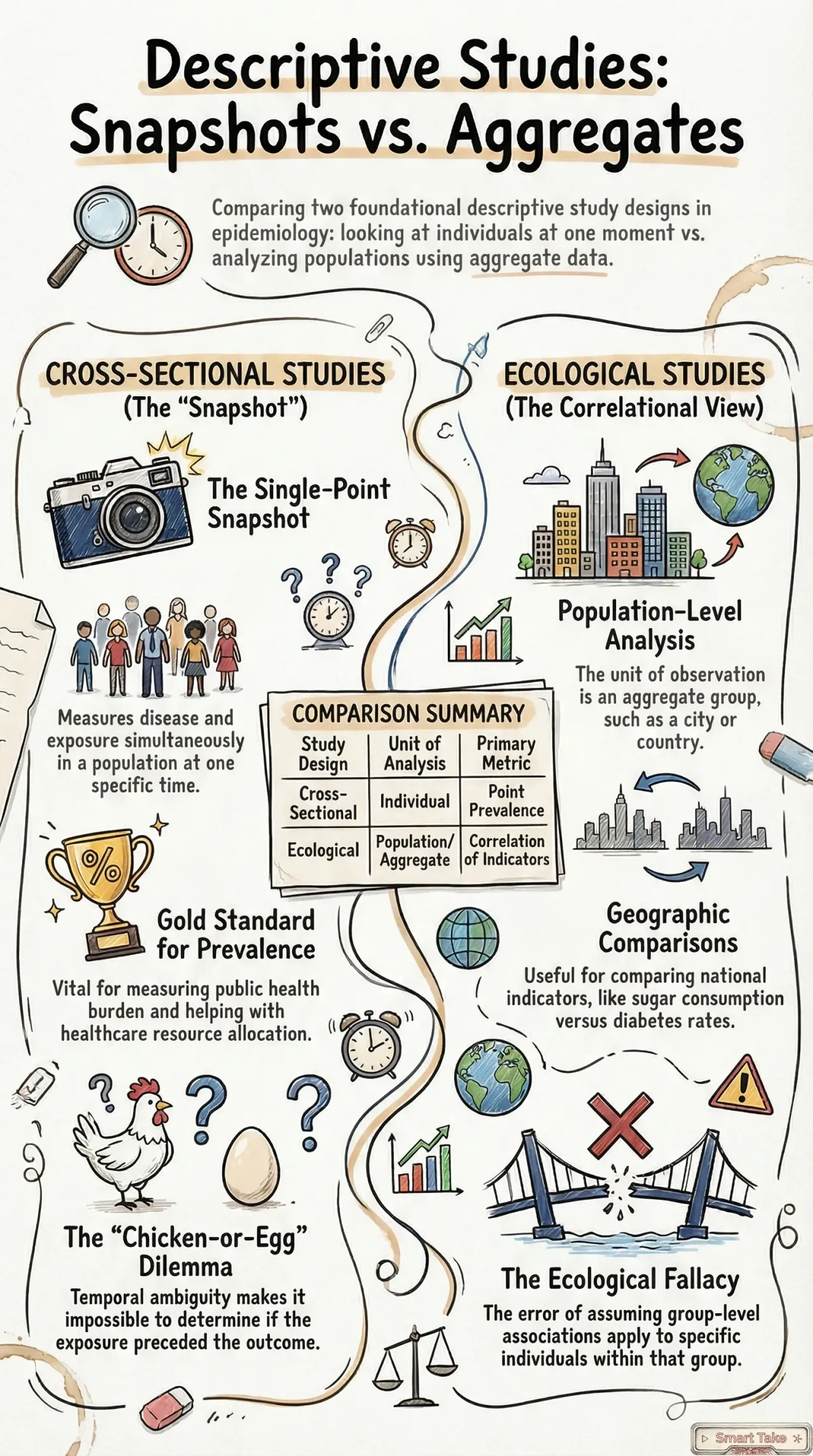
Descriptive studies in biomedical research, specifically cross-sectional and ecological designs, provide a snapshot of health characteristics and exposures within populations. Cross-sectional studies measure the prevalence of outcomes and exposures in individuals at a single point in time, making them ideal for public health planning but limited by temporal ambiguity. In contrast, ecological studies use populations or groups as the unit of analysis to identify correlations between aggregate variables. While useful for generating hypotheses and comparing geographic regions, ecological studies are prone to the 'ecological fallacy,' where population-level associations are incorrectly attributed to individuals.
Key points
- Cross-Sectional Studies: Known as 'snapshot' studies; they measure disease prevalence and exposure simultaneously.
- Primary Utility: Best for determining the public health burden and resource allocation.
- Temporal Ambiguity: The main limitation of cross-sectional studies; they cannot establish a temporal sequence (cause-and-effect).
- Ecological Studies: Also called correlational studies; the unit of observation is a group/population (e.g., country, city) rather than an individual.
- Ecological Fallacy: A critical error where group-level associations are wrongly applied to individuals within that group.
1. Cross-Sectional Studies
- Definition: A study that examines the relationship between diseases (outcomes) and other variables (exposures) in a defined population at one specific point in time.
- Mechanism:
- Simultaneous measurement of exposure and outcome.
- Provides a 'snapshot' of the population health status.
- Applications:
- Calculating Point Prevalence (the proportion of a population with a condition at a specific time).
- Healthcare planning and administrative resource allocation.
- Advantages:
- Relatively fast to conduct.
- Inexpensive compared to longitudinal studies.
- Limitations:
- Temporal Ambiguity: Since exposure and outcome are measured at the same time, it is impossible to determine if the exposure preceded the outcome.
- Cannot establish a definitive cause-and-effect relationship.
2. Ecological Studies (Correlational Studies)
- Definition: Studies where the unit of analysis is a group or aggregate of individuals (e.g., populations of a city, state, or nation) rather than the individuals themselves.
- Mechanism: Uses existing databases to compare broad health indicators and exposures across different geographic regions or time periods.
- Example: Comparing per capita sugar consumption of various countries against their national diabetes rates.
- The Ecological Fallacy:
- A logical error in interpreting data.
- Occurs when a researcher assumes that an association found at the aggregate/group level applies to every individual within that group.
- Illustration: Higher average national income correlating with higher heart disease rates does not mean every wealthy individual in that nation is at higher risk.