BCBR
Topic 15 · Designing data collection tools
Anatomy of a good questionnaire
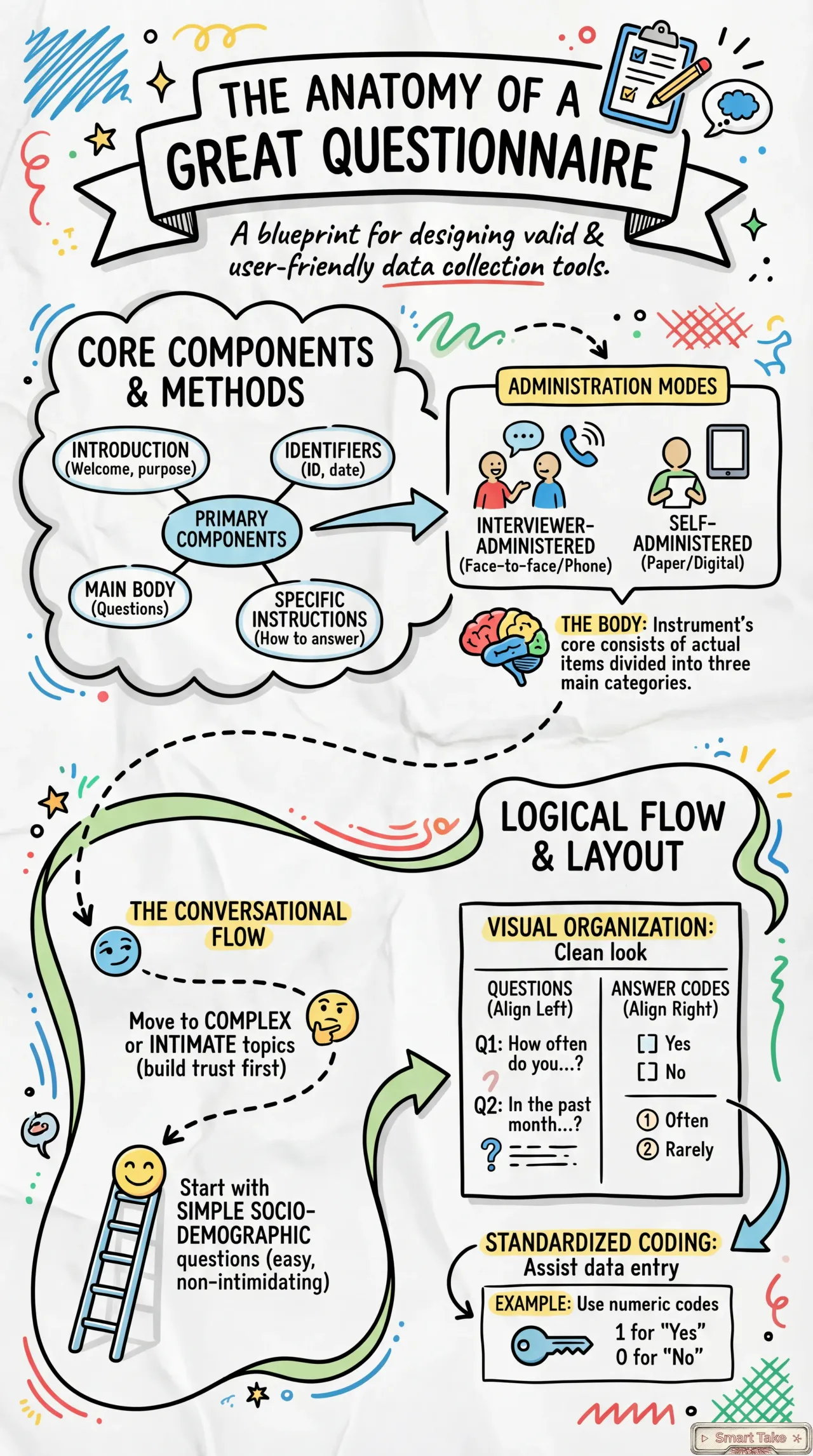
The questionnaire is the most critical tool for data collection in biomedical research, requiring meticulous structuring and formatting to ensure validity. A robust instrument comprises four core components: introduction/conclusion, identifiers, instructions, and the body. Question types range from open-ended (for hypothesis generation) to closed and semi-open (for standardized data). Effective formulation relies on clarity, simplicity, and the avoidance of bias or double-barreled structures. The physical layout and logical flow, moving from general to sensitive topics, are essential for maintaining respondent engagement and facilitating accurate data entry.
Key points
- Modes of Administration: Can be interviewer-administered or self-administered (paper or computer-assisted).
- Core Components: Introduction, Identifiers, Instructions, Body, and Sign-off.
- Question Categories: Open (unrestricted), Closed (dichotomous, multiple-choice, or quantitative), and Semi-open (includes 'Others' category).
- Formulation Principles: Use short, positive, and single-intent (not double-barreled) sentences.
- Question Order: Follow a natural flow from simple/general to complex/intimate topics.
- Layout Standards: Use readable fonts (size 11-12), avoid splitting questions across pages, and align codes to the right for easy data entry.
1. Components of a Questionnaire
- Introduction and Conclusion: Sets the stage and provides a professional closing.
- Identifiers: Unique codes or names to track respondents.
- Instructions: Guidance for both data collectors and participants.
- The Body: The core section containing the actual research items.
2. Types of Questions
- Open Questions:
- No suggested answers; provides total freedom.
- Best for hypothesis-generating stages and capturing unanticipated responses.
- Closed Questions:
- Dichotomous: Two options (e.g., Yes/No); forces a focused position but may oversimplify.
- Multiple Options: Single or multiple answers allowed (e.g., frequency scales).
- Quantitative: Generates continuous variables (e.g., Age, GCS score, number of visits).
- Semi-Open Questions:
- Provides suggested responses plus an "Others (specify)" category for unplanned answers.
3. Principles of Question Formulation
- Clarity and Precision: Use complete sentences and everyday language (e.g., "What is your age?" instead of "Age?").
- Positive Phrasing: Avoid negatives and double negatives to prevent respondent confusion.
- Single Intent: Avoid "double-barreled" questions. Split multi-part inquiries into separate items.
- Specificity: List specific practices rather than asking vague, open-ended questions when looking for specific knowledge.
- Neutrality: Use non-judgmental language to avoid influencing the respondent (e.g., asking for partner count instead of using the term "promiscuous").
4. Logic, Flow, and Layout
- Sequence:
- Start with simple/casual (socio-demographics).
- Move to complex/specific/intimate (drug use, sexual history).
- Group related topics and maintain chronological order for events.
- Triangulation: Ask about critical topics in multiple ways to verify consistency.
- Physical Formatting:
- Use font sizes 11 or 12.
- Ensure adequate spacing and clear section breaks.
- Crucial Rule: Never split a single question across two pages.
- Alignment: Questions on the left; codes/answers on the right.
- Coding: Standardize coding (e.g., Yes = 1, No = 0) directly on the instrument to streamline data entry.