BCBR
Topic 15 · Designing data collection tools
Questionnaire design
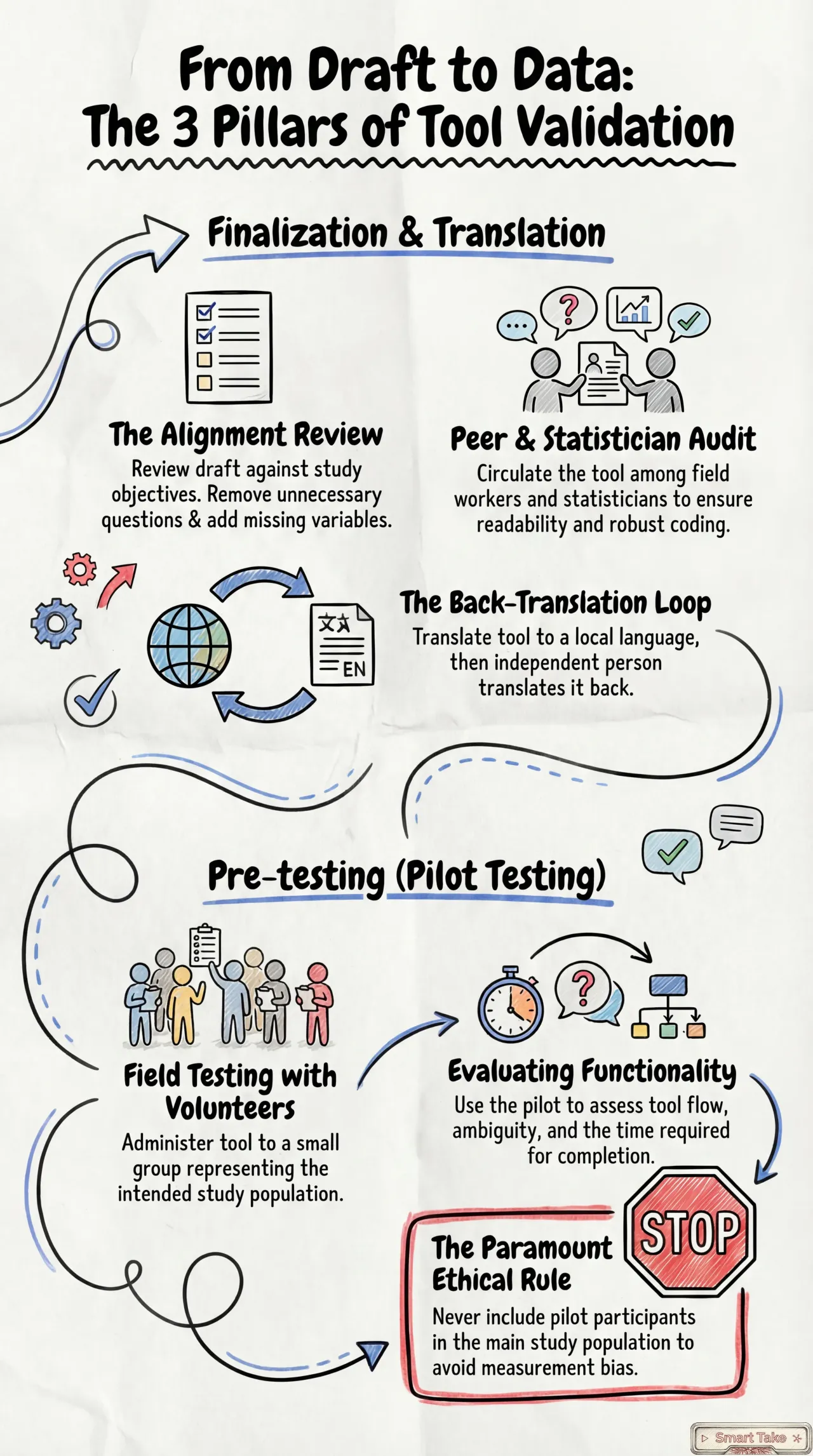
Designing and finalizing a data collection tool is a foundational step in biomedical research that must align strictly with study objectives and the statistical analysis plan. The process involves a rigorous cycle of internal review, expert consultation (including statisticians), and peer feedback to ensure the instrument is robust and unambiguous. For studies involving diverse populations, the tool must undergo a formal translation and back-translation process to maintain linguistic validity. Finally, a pilot test (pre-testing) with a small, independent group is mandatory to evaluate the tool's clarity, acceptability, flow, and time requirements before full-scale deployment.
Key points
- Objective Alignment: The investigator must ensure every question serves a specific study objective or analysis need.
- Expert Review: Peer and statistician reviews are essential to catch ambiguities and ensure data compatibility with software.
- Linguistic Validity: Tools must be administered in the participants' primary language; English drafts require back-translation for verification.
- Back-translation: A method where an independent person translates the local-language tool back to English to check for equivalence with the original.
- Pre-testing (Pilot Study): A field test conducted on a small group similar to, but separate from, the actual study population.
- Exclusion Rule: Participants involved in the pilot test must be excluded from the main study to prevent pre-exposure bias.
- Metric Assessment: Pre-testing determines the exact time required per questionnaire for logistics planning.
I. Finalizing the Instrument
- Objective-Driven Design: The investigator is a "slave" to study objectives.
- Remove redundant questions not serving the objectives.
- Add missing questions required for the analysis plan.
- Review Process:
- Peer Review: Circulate among colleagues and field workers to check for flow and readability.
- Statistician Review: Essential for verifying the coding system and ensuring data integrates with planned statistical tests.
II. The Translation Process
- Requirement: Tools must be in the primary language of the participants (e.g., Hindi, Tamil, Malayalam).
- Meticulous Translation Steps:
- Forward Translation: Original English draft is translated into the local language.
- Back-translation: An independent individual (not the investigator) translates the local version back into English.
- Comparison: The investigator compares the back-translated version with the original English version.
- Validation: The translation is valid only if the two English versions are equivalent in meaning.
III. Pre-testing (Pilot Testing)
- Definition: Administering the finalized tool to a small group of volunteers from a population similar to the target population.
- Objectives of Pilot Testing:
- Clarity and Understandability: Do participants comprehend questions as intended?
- Acceptability: Are questions offensive? Are participants comfortable answering?
- Flow and Mechanics: Do skip patterns work? Is the logical flow maintained? Is coding pertinent?
- Time Assessment: Measuring the actual time needed per respondent for logistical planning.
- The Golden Rule of Pre-testing:
- Volunteers in the pilot test must not be included in the main study.
- Reason: Prevents bias due to pre-exposure to study concepts or measurement scales.