BCBR
Foundations of research ethics
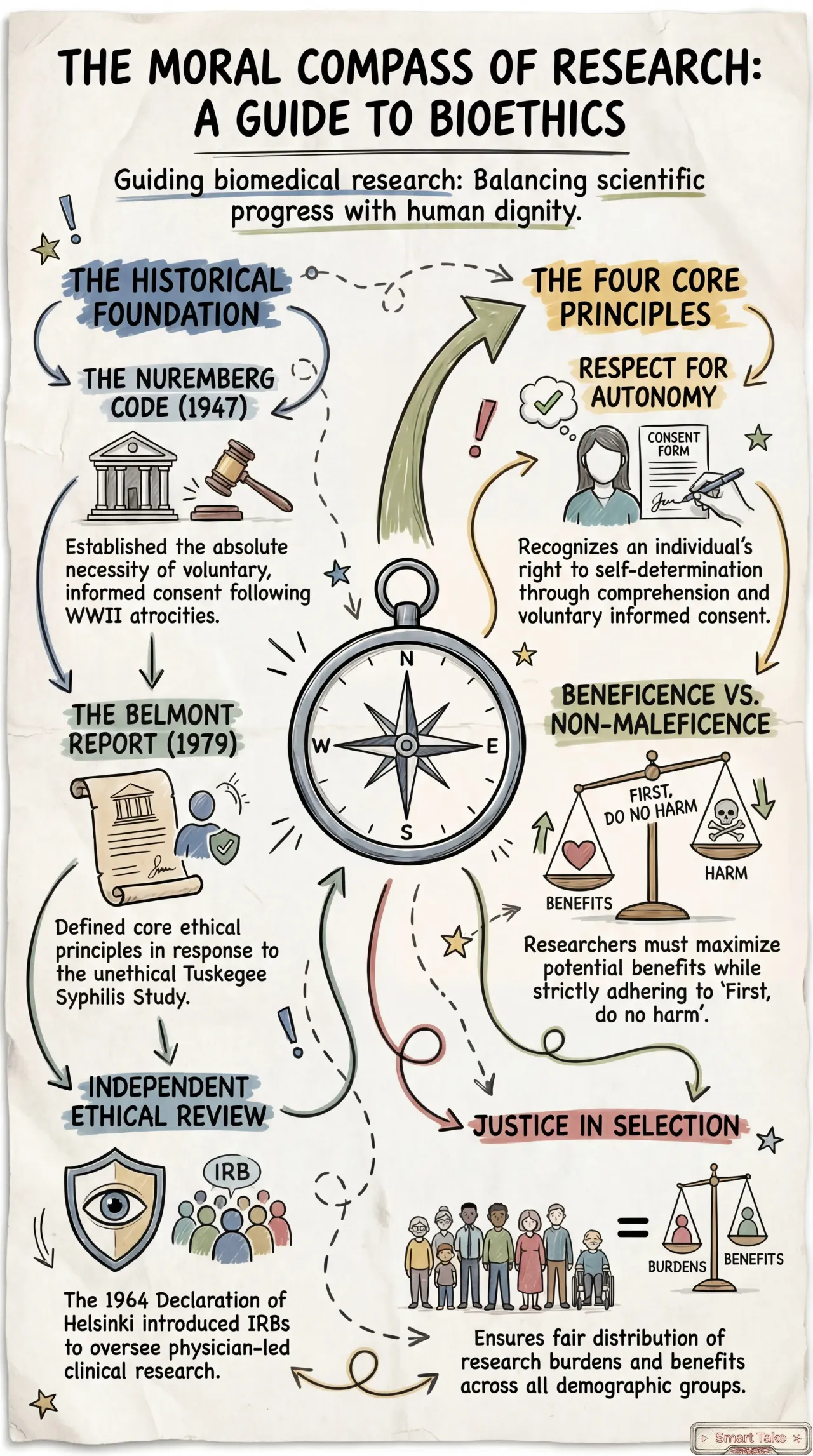
Bioethics in biomedical research is an essential moral framework developed in response to historical human rights violations. It traces its origins from the Nuremberg Code (1947), the Declaration of Helsinki (1964), and the Belmont Report (1979). These foundational documents established the necessity of voluntary informed consent, independent ethical review, and the protection of human subjects. Modern bioethics is governed by the four core principles of Principlism: Respect for Autonomy, Beneficence, Non-Maleficence, and Justice. These principles ensure that scientific advancement, including modern AI-driven research, prioritizes human dignity, fair distribution of benefits, and the minimization of risk.
Key points
- Nuremberg Code (1947): First international document to mandate voluntary informed consent following Nazi experiments.
- Declaration of Helsinki (1964): Introduced Institutional Review Boards (IRBs) for independent ethical oversight.
- Belmont Report (1979): Created in response to the Tuskegee Syphilis Study; defined core ethical pillars.
- Respect for Autonomy: Focuses on self-determination through informed consent and voluntary participation.
- Beneficence: Obligation to maximize potential benefits and ensure sound scientific design.
- Non-Maleficence: The duty to "do no harm" by minimizing risks to participants.
- Justice: Ensuring fairness in subject selection and the equitable distribution of research burdens and benefits.
1. Historical Evolution of Bioethics
- The Nuremberg Code (1947)
- Origin: Result of the Doctors' Trial after WWII.
- Key Mandate: Absolute necessity of voluntary, informed consent.
- Requirement: Research must yield fruitful results for the good of society.
- The Declaration of Helsinki (1964)
- Issued by: World Medical Association (WMA).
- Focus: Specifically addressed clinical research by physicians.
- Innovation: Introduced independent ethical review committees (IRBs/IECs).
- The Belmont Report (1979)
- Catalyst: Public outcry over the Tuskegee Syphilis Study (unprivileged men left untreated for decades).
- Purpose: To explicitly define the core principles governing ethical research in the U.S. and beyond.
2. The Four Principles of Principlism
- A. Respect for Autonomy
- Definition: Recognition of an individual's right to self-determination.
- Informed Consent Requirements:
- Full Disclosure: Subjects must receive all necessary info.
- Comprehension: Subjects must understand the info provided.
- Voluntariness: Participation must be free from coercion or undue influence.
- Right to Withdraw: Subjects can leave at any time without penalty.
- B. Beneficence
- Definition: Obligation to act in the participant's best interest.
- Action: Maximize potential benefits to subjects and society.
- Scientific Integrity: A study must be well-designed; poor design is inherently unethical as it risks subjects for no valid data.
- C. Non-Maleficence
- Definition: "First, do no harm."
- Action: Minimize foreseeable risks.
- Assessment: Risks must be reasonable in relation to anticipated benefits (Risk-Benefit Ratio).
- D. Justice
- Definition: Fairness in the distribution of research burdens and benefits.
- Fair Subject Selection: Do not target vulnerable populations (prisoners, impoverished) just for ease of access.
- Equitable Access: Do not unjustly exclude groups (pregnant women, children) from the benefits of research.
3. Modern Application (e.g., AI and Data)
- Autonomy: Verification of consent for data usage in training algorithms.
- Beneficence: Ensuring technology actually improves patient outcomes.
- Non-Maleficence: Mitigating risks of false positives/negatives in diagnostic AI.
- Justice: Ensuring datasets are diverse and representative to avoid demographic bias.