BCBR
Ethical principles and informed consent
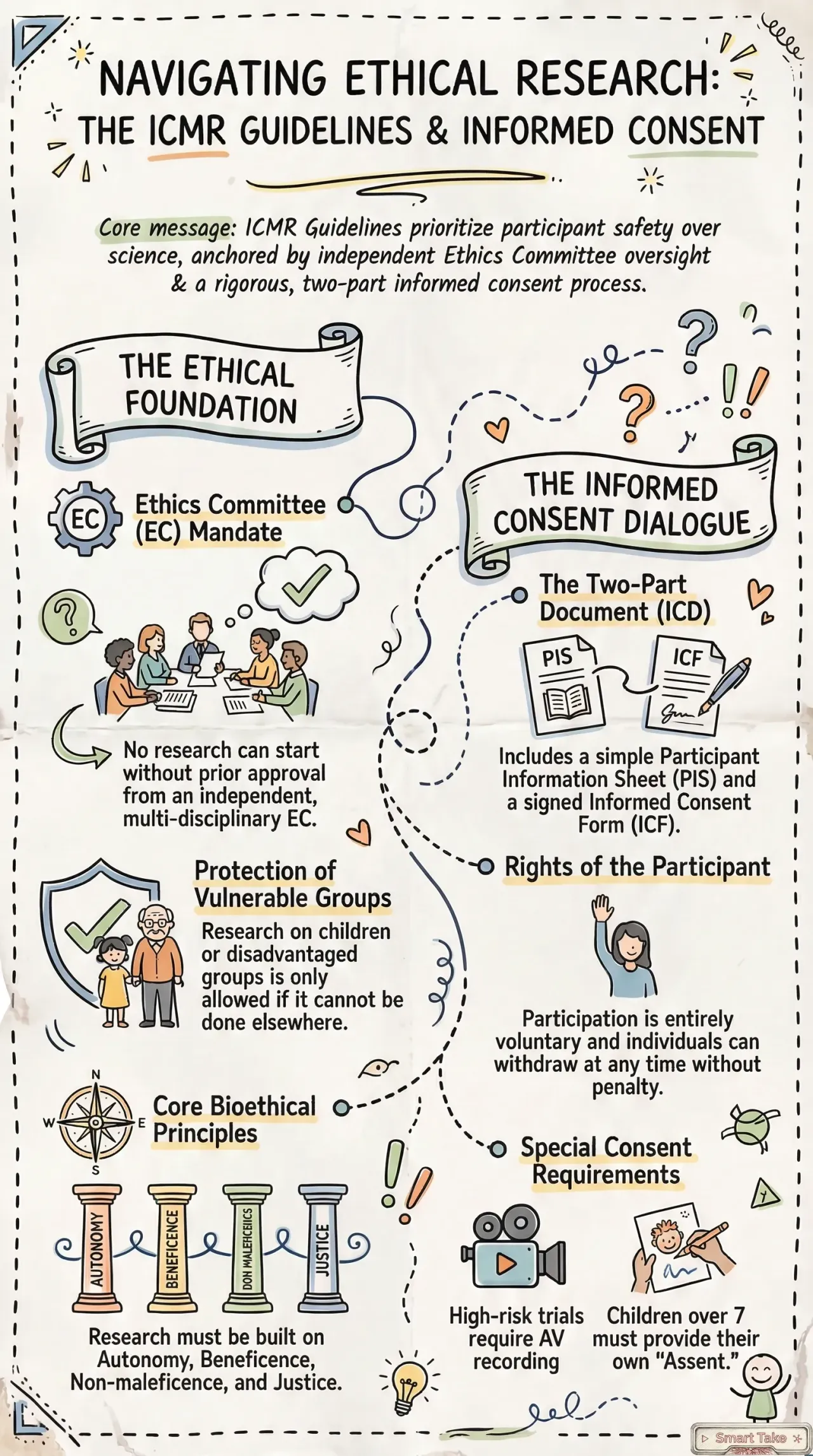
This module outlines the mandatory ethical framework for biomedical research in India as governed by the Indian Council of Medical Research (ICMR). It details the critical role of the Ethics Committee (EC) in overseeing research involving human participants and emphasizes the localization of core bioethical principles. A significant portion is dedicated to the Informed Consent process, which is defined as a continuous educational dialogue rather than a mere administrative task. The documentation is divided into the Participant Information Sheet (PIS) and the Informed Consent Form (ICF), ensuring transparency regarding risks, benefits, and participant rights. Furthermore, the guidelines establish rigorous protections for vulnerable populations, including requirements for Audio-Visual (AV) recording and the necessity of obtaining 'Assent' from minors.
Key points
- ICMR Mandate: All biomedical research in India must comply with the National Ethical Guidelines for Biomedical and Health Research Involving Human Participants.
- Ethics Committee (EC): An independent, multidisciplinary body that must provide prior approval for any study.
- Informed Consent Document (ICD): Consists of two parts: the Participant Information Sheet (PIS) and the Informed Consent Form (ICF).
- Vulnerability: Research on vulnerable groups is only permitted if it cannot be done on less vulnerable populations and is directly relevant to their health needs.
- Assent: Required for children (typically >7 years) in addition to parental/LAR consent.
- AV Recording: Mandatory for high-risk clinical trials or vulnerable populations to prevent coercion.
- Participant Rights: Voluntariness, confidentiality, and the right to withdraw without affecting standard care are paramount.
1. The ICMR National Ethical Guidelines
- Scope: Applies to all biomedical and health research involving human participants in India.
- Ethics Committee (EC) Composition: Includes medical scientists, clinicians, legal experts, social scientists, and laypersons.
- Core Principles: Localization of Autonomy, Beneficence, Non-maleficence, and Justice.
- Specific Directives: Focus on voluntariness, privacy, confidentiality, risk minimization, and accountability.
- Vulnerable Populations: Includes children, pregnant women, elderly, economically disadvantaged, terminally ill, and tribal populations.
2. The Informed Consent Process
- Definition: A continuous educational process and dialogue, not just a signature.
- Objective: Ensuring absolute comprehension by the participant.
- Components of the ICD:
- Participant Information Sheet (PIS): The educational component.
- Informed Consent Form (ICF): The certificate of agreement.
3. Participant Information Sheet (PIS) Details
- Language: Simple, non-technical, local language (8th-grade reading level).
- Essential Content:
- Aim of study: Clear explanation of goals (e.g., vaccine testing).
- Selection Criteria: Why the specific participant was chosen.
- Procedures: Details on blood volume, hospital visits, and duration.
- Risks/Discomforts: Full transparency on side effects.
- Benefits: Must distinguish between societal benefits and participant benefits. Note: Reimbursement for time/travel is not a benefit.
- Confidentiality: How identity is protected.
- Injury Management: Mechanism for free medical management and financial compensation for trial-related injuries.
- Contacts: Details for the Principal Investigator (PI) and the Ethics Committee (EC).
4. The Informed Consent Form (ICF) & Special Cases
- Participant Confirmation: Signifies they read/understood the PIS, asked questions, understand participation is voluntary, and agree to join.
- Audio-Visual (AV) Recording: Mandated for vulnerable populations or high-risk trials (e.g., New Chemical Entities) to ensure no coercion.
- Research Involving Minors:
- Consent: Must be provided by parents or Legally Authorized Representatives (LAR).
- Assent: Affirmative agreement from the child (usually >7 years) based on maturity.
- Refusal: If a child refuses (Dissent), they cannot be forced to participate, regardless of parental consent.
- Priority: The rights, safety, and well-being of subjects always supersede the interests of science and society.