BCBR
Topic 07 · Experimental study designs
Experimental studies and the basics of RCTs
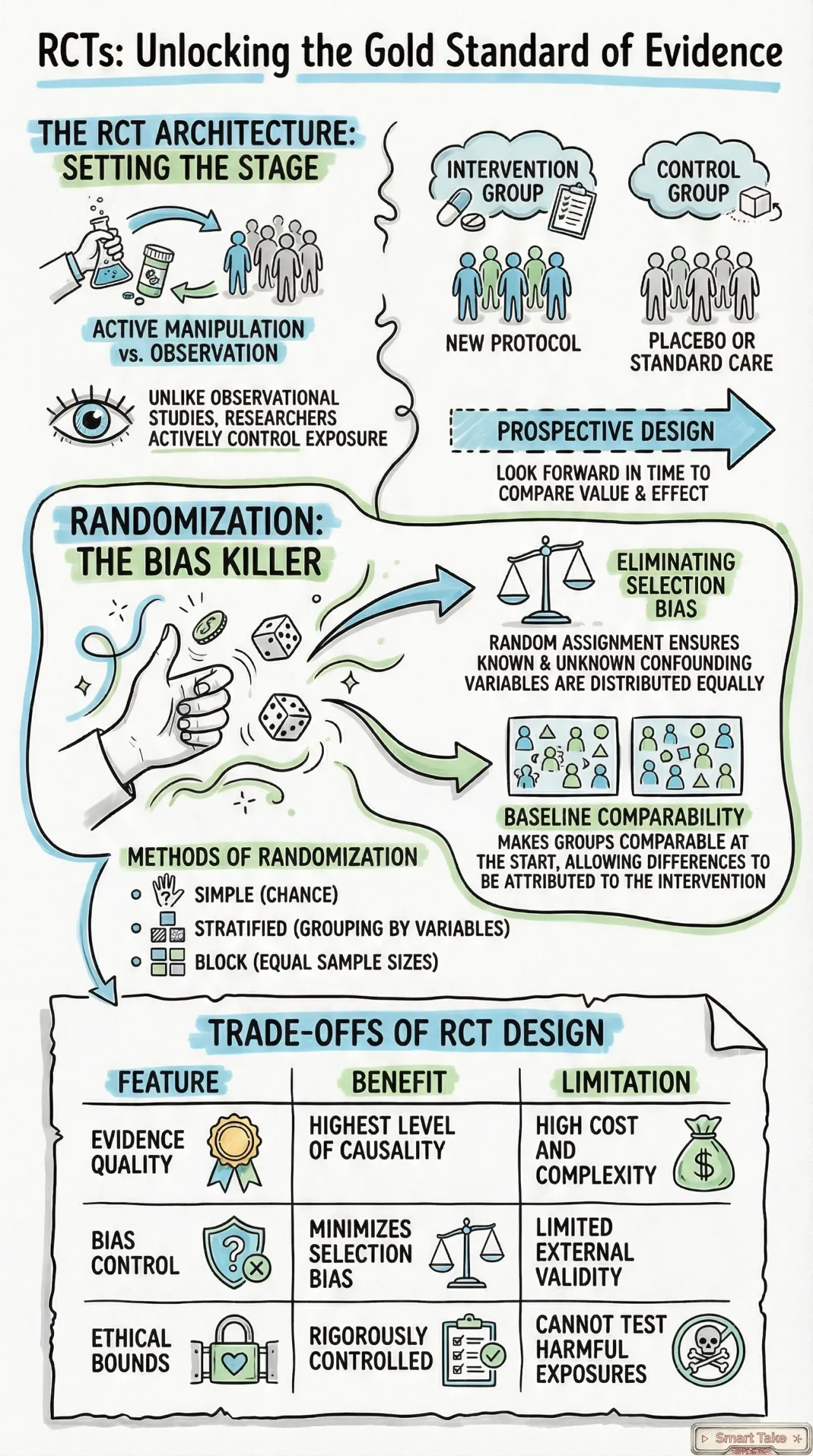
Experimental studies, specifically Randomized Controlled Trials (RCTs), represent the gold standard of epidemiological evidence. Unlike observational designs, experimental studies involve the active manipulation of an intervention by the researcher to determine its effect on a specific outcome. By using randomization to assign participants to either an intervention or a control group, researchers ensure that both known and unknown confounding variables are balanced at baseline. This rigorous process eliminates selection bias, allowing for a definitive determination of causality between the intervention and the observed results.
Key points
- Experimental vs. Observational: Experimental studies involve active researcher intervention, whereas observational studies involve passive monitoring of natural exposures.
- The Gold Standard: The Randomized Controlled Trial (RCT) is the pinnacle of evidence for establishing causality.
- Core Feature: Randomization is the defining characteristic that distinguishes RCTs from other study designs.
- Primary Goal: The absolute purpose of randomization is to eliminate Selection Bias.
- Comparability: Randomization ensures that intervention and control groups are comparable at baseline regarding all potential confounders.
- Control Groups: Essential for comparison; may receive a placebo, standard of care, or no intervention.
1. Definition and Nature of RCTs
- Prospective Design: RCTs follow participants forward in time to observe outcomes.
- Active Manipulation: The investigator controls the exposure (the intervention).
- Comparison: Always involves at least two groups:
- Intervention Group: Receives the new drug, device, or protocol.
- Control Group: Receives the placebo, standard of care, or no treatment.
2. Randomization Mechanics
- Definition: The statistical process of assigning subjects to groups using an element of chance.
- Function: Distributes both known and unknown confounding variables equally across groups.
- Methods of Randomization:
- Simple Randomization: Basic methods like coin tossing or random number tables.
- Stratified Randomization: Subjects are first grouped by key variables (e.g., age, disease stage) to ensure balance within those specific categories.
- Block Randomization: Used to ensure equal sample sizes are maintained across groups over the duration of the trial.
3. Advantages of RCTs
- Causality: Provides the highest level of proof that an intervention causes an outcome.
- Bias Minimization: Specifically targets and eliminates selection bias.
- Rigorous Control: Offers the most controlled environment for testing clinical hypotheses.
4. Limitations and Constraints
- Logistics: High cost, significant complexity, and long timeframes for completion.
- External Validity: Highly controlled environments may not reflect "real-world" clinical practice (limited generalizability).
- Ethical Constraints: Researchers cannot experimentally expose subjects to known harmful agents or toxins.
- Baseline Balance: While randomization aims for balance, it does not guarantee it in very small sample sizes, though it remains the best method available.