BCBR
Topic 07 · Experimental study designs
Blinding and trial designs
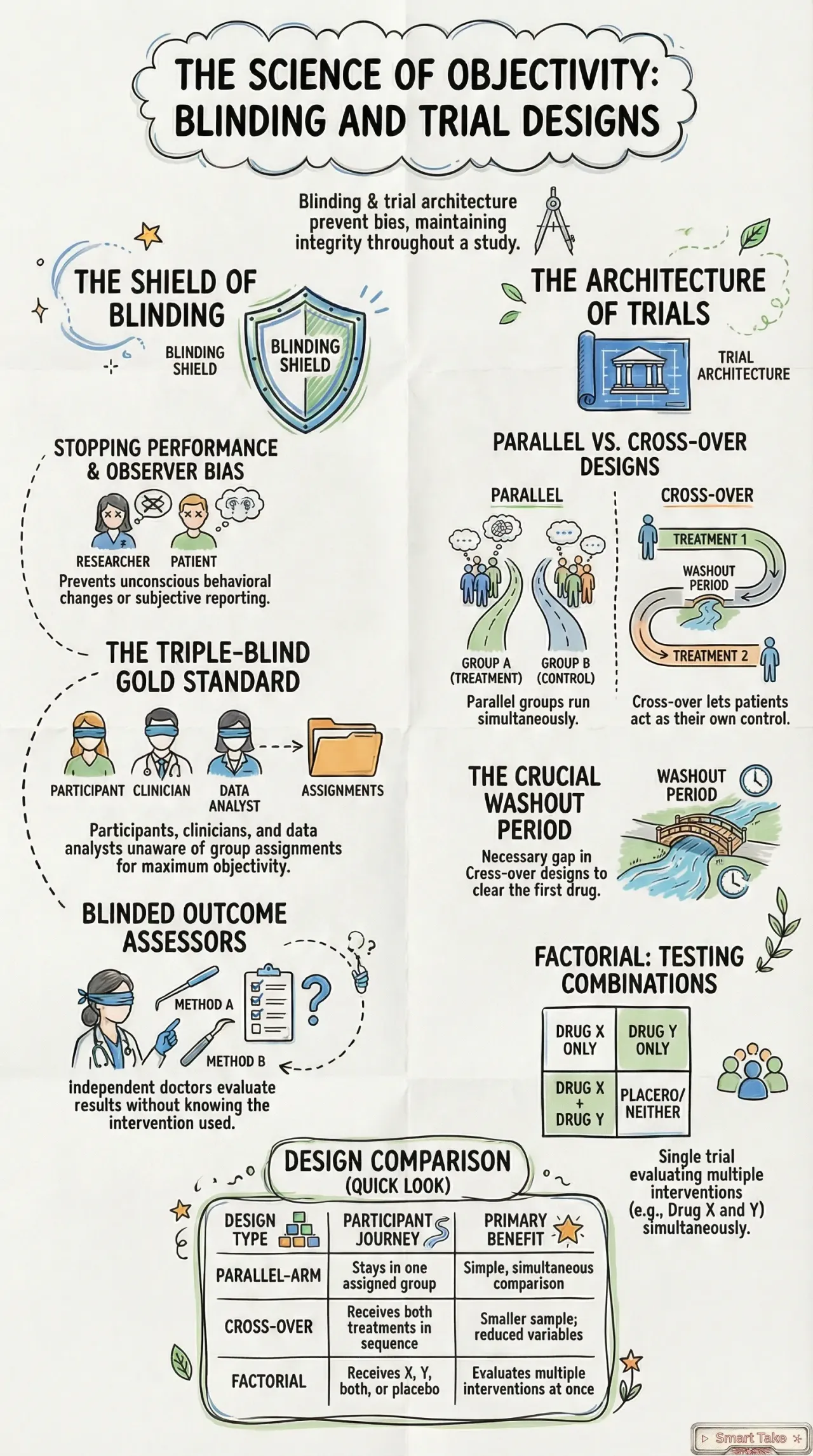
This module covers the critical methodologies of blinding and various trial designs in Randomized Controlled Trials (RCTs). Blinding (or masking) is an essential technique used to eliminate bias throughout the conduct and analysis phases of a study. While randomization addresses selection bias at the start, blinding prevents performance and ascertainment bias by keeping participants, investigators, or analysts unaware of treatment assignments. The document also details structural trial designs, including Parallel-Arm, Cross-Over, and Factorial designs, highlighting their specific applications, advantages like the 'washout period,' and ethical constraints in clinical research.
Key points
- Blinding's Purpose: To prevent bias during the study conduct (performance bias) and outcome assessment (ascertainment/observer bias).
- Levels of Blinding: Categorized into Single-blind, Double-blind (the gold standard), and Triple-blind based on who remains unaware of the intervention.
- Parallel-Arm Design: The most common RCT structure where participants stay in one assigned group throughout.
- Cross-Over Design: Participants receive all interventions in a sequence, acting as their own controls, requiring a smaller sample size.
- Washout Period: A necessary interval in cross-over trials to eliminate the residual effects of the first treatment.
- Factorial Design: Allows for the simultaneous testing of two or more independent interventions.
- Blinded Outcome Assessors: Used when double-blinding is impossible (e.g., surgery) to maintain objective evaluation.
1. The Necessity of Blinding (Masking)
- Function: Unlike randomization (which stops selection bias), blinding prevents bias during the trial's execution and data analysis.
- Bias Types Prevented:
- Performance Bias: Occurs when doctors or staff provide different levels of care or attention to the experimental group vs. the control group.
- Ascertainment (Observer) Bias: Occurs when researchers interpret subjective or marginal outcomes more favorably for the experimental group.
- Goal: Ensures that efficacy results are objective and not influenced by the expectations of participants or researchers.
2. Levels of Blinding
- Single-Blind: Only the participant is unaware of the treatment assignment.
- Double-Blind: Both the participant and the treating investigator/clinician are unaware. This is the optimal standard for drug trials.
- Triple-Blind: The participant, the clinician, and the data analyst/statistician are all unaware of group assignments until the study is officially unblinded.
3. Trial Designs
- Parallel-Arm Design:
- Participants are randomized into two or more distinct groups.
- Groups run simultaneously.
- Each participant receives only one intervention.
- Cross-Over Design:
- Every participant receives both interventions in a specific sequence.
- Example: Group 1 (A then B); Group 2 (B then A).
- Washout Period: A mandatory gap between treatments to ensure the first drug's effects are cleared from the system to avoid "carry-over" effects.
- Advantage: Participants serve as their own controls, reducing confounding variables and requiring smaller sample sizes.
- Factorial Design (e.g., 2x2):
- Evaluates multiple interventions at once.
- Example Groups: Drug X only, Drug Y only, both Drug X and Y, and Placebo.
4. Practical and Ethical Considerations
- Impossible Blinding: In cases like surgery or psychotherapy, double-blinding is physically impossible.
- Blinded Outcome Assessors: A solution for unblindable trials where independent doctors (who didn't perform the procedure) evaluate the outcomes to neutralize observer bias.
- Ethics of Placebo: If a proven standard-of-care exists, using a placebo is often unethical. In such cases, researchers use active-control parallel designs to test for non-inferiority.