BCBR
Topic 02 · Hypothesis and objectives
Formulating the research question: FINER and PICO
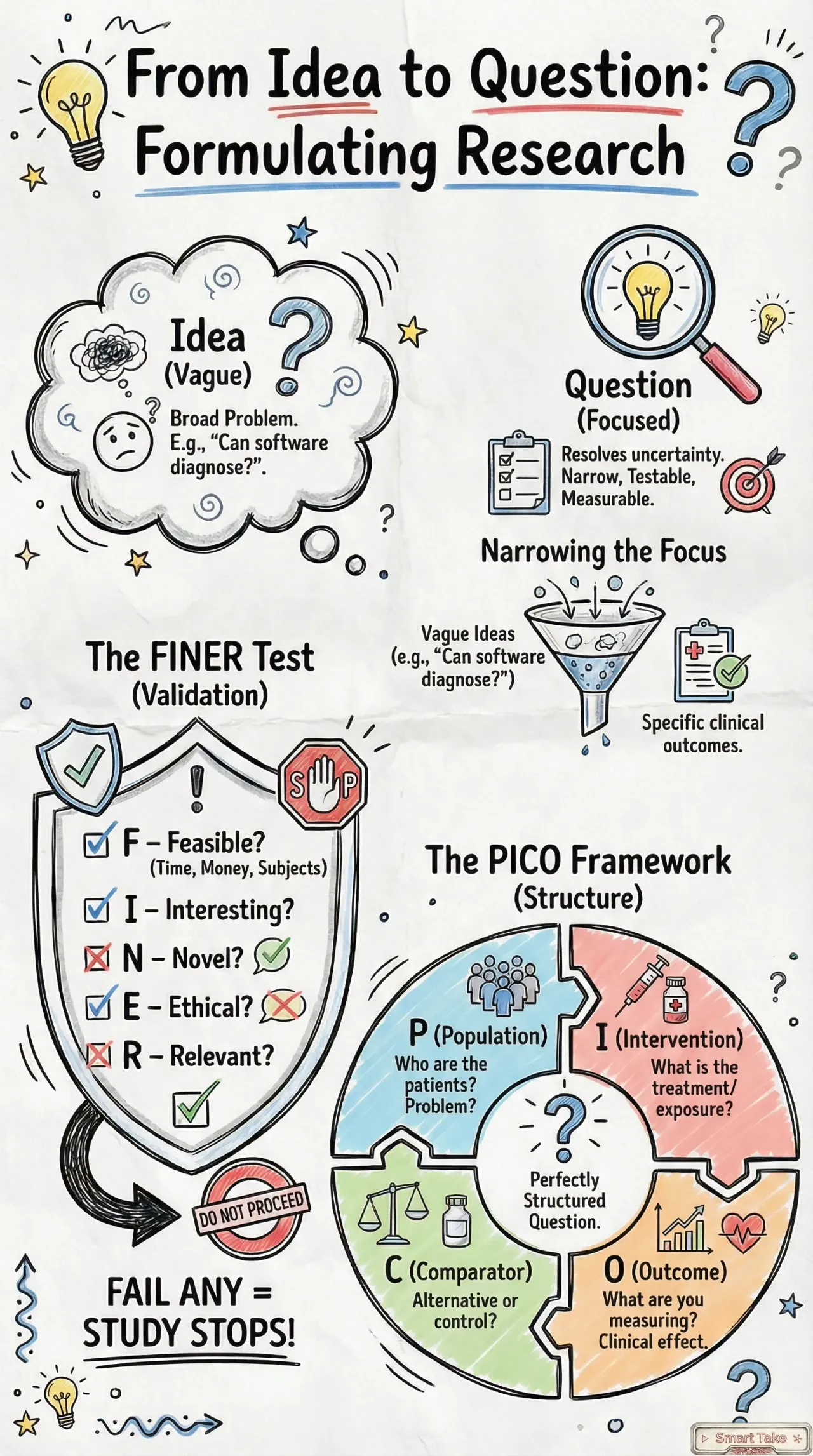
Research in biomedical fields begins with a broad idea or problem, but must be refined into a specific, testable research question that addresses a particular uncertainty. A well-formulated research question is the foundation of a successful study, transforming a vague clinical problem into a structured inquiry. To ensure a question is both scientifically sound and practically viable, researchers utilize two primary frameworks: the FINER criteria for evaluating the feasibility and relevance of the study, and the PICO format for structuring the clinical components of the question. Mastery of these frameworks is essential for creating studies that are ethical, manageable, and impactful for clinical practice or public health policy.
Key points
- Research Question vs. Idea: A research question must be narrow, focused, and directly testable, unlike a broad clinical idea.
- FINER Criteria: Used to judge if a research question is worth pursuing (Feasible, Interesting, Novel, Ethical, Relevant).
- PICO Framework: Used to structure the specific elements of a clinical research question (Population, Intervention, Comparator, Outcome).
- Feasibility: Primarily concerns sample size, technical expertise, time, and budget.
- Ethics: Every research question must pass the Institutional Ethics Committee (IEC) and avoid unacceptable risks.
- Comparators: Essential for defining what the new intervention is being measured against (e.g., gold standard or placebo).
1. From Idea to Research Question
- Definition: A research question is the specific uncertainty the investigator wants to resolve.
- Characteristics:
- Must be narrow and focused.
- Must be directly testable.
- Example: Transforming "Can software help patients?" (Vague) into "Does an AI app improve early detection of respiratory anomalies in adult outpatients compared to physician assessment?" (Structured).
2. The FINER Criteria
Before starting a study, the question must satisfy all five FINER points:
- F - Feasible:
- Adequate number of subjects (Sample Size).
- Adequate technical expertise.
- Affordable in time and money.
- Manageable in scope.
- I - Interesting:
- Must motivate the investigator.
- Must interest the scientific community and funding agencies.
- N - Novel:
- Provides new findings.
- Confirms or refutes previous findings.
- Extends previous findings to new populations/settings.
- E - Ethical:
- Cannot subject participants to unacceptable physical or psychological risks.
- Must be approved by the Institutional Ethics Committee (IEC).
- R - Relevant:
- Must impact clinical practice, health policy, or future research directions.
3. The PICO Framework
This framework is used to build the anatomy of the research question:
- P - Population (Patient or Problem):
- Defines who is being studied.
- Includes specific characteristics (e.g., age, gender, clinical condition).
- Example: Adult outpatients (18-60 years) with chronic cough.
- I - Intervention (or Indicator):
- The new treatment, diagnostic test, or exposure being evaluated.
- Example: Screening via an AI-powered diagnostic app.
- C - Comparator (or Control):
- The standard of comparison.
- Can be the current 'gold standard' of care, a placebo, or no intervention.
- Example: Standard clinical assessment by a resident physician.
- O - Outcome:
- The specific, measurable endpoint or result.
- Example: The rate of early detection of respiratory anomalies.