BCBR
Topic 02 · Hypothesis and objectives
Defining hypotheses and objectives
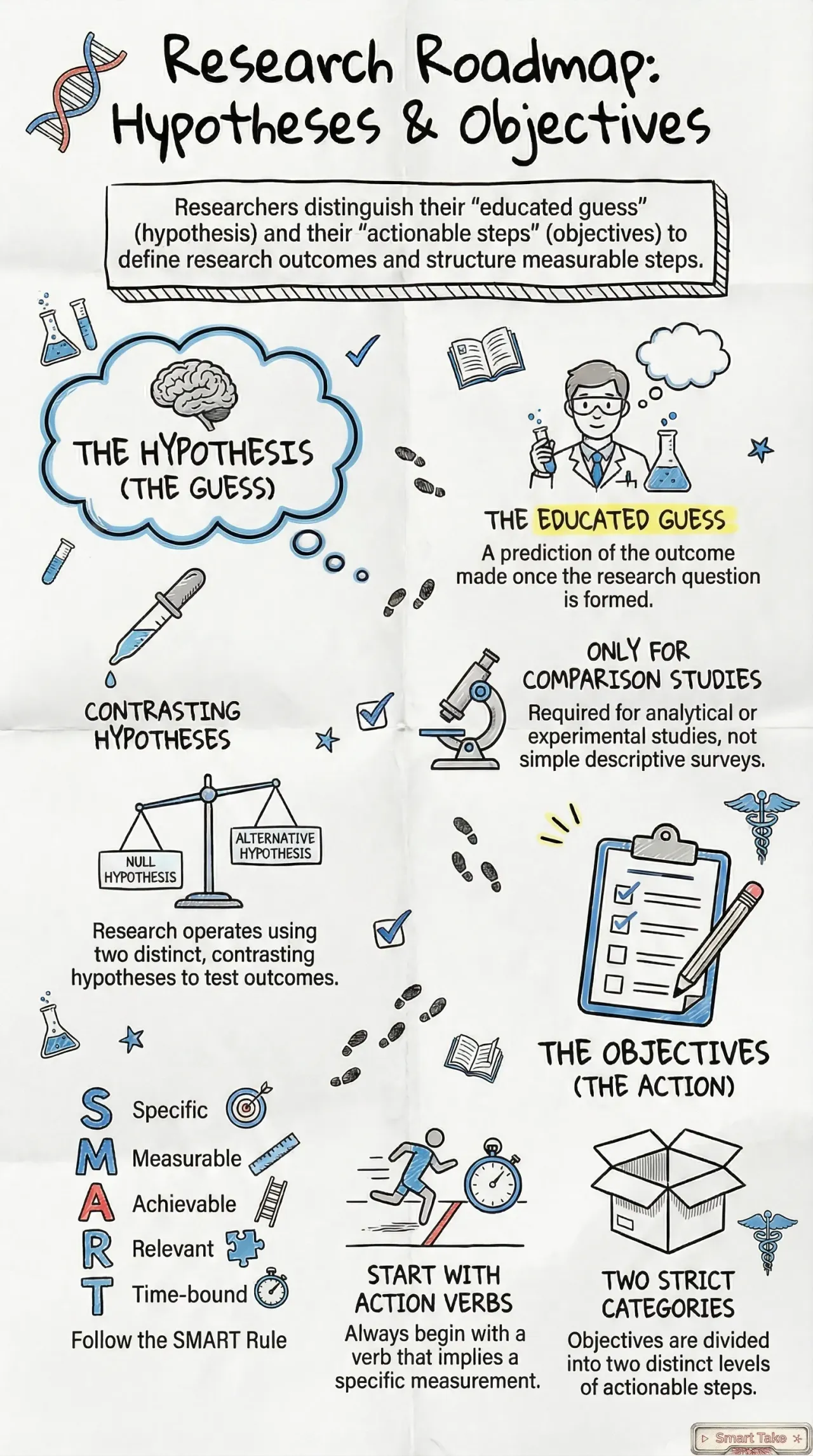
Defining Hypotheses and Objectives is a critical step in the research process that bridges the research question with the study design. Hypotheses are educated guesses about study outcomes, typically categorized into the Null Hypothesis , which assumes no effect, and the Alternate Hypothesis , which assumes a difference or association. Objectives are actionable, measurable steps derived from the research question, categorized into a single Primary Objective (used for sample size calculation) and multiple Secondary Objectives. Quality objectives must follow the SMART criteria and utilize specific action verbs to ensure they are statistically evaluable.
Key points
- Hypotheses are required for analytical and experimental studies, but not for simple descriptive studies.
- Null Hypothesis represents 'no difference' and is the hypothesis that researchers aim to reject.
- Alternate Hypothesis represents the expected effect or association.
- Primary Objective: Every study has exactly one; it dictates the sample size calculation.
- Secondary Objectives: Multiple objectives that explore additional outcomes; the study may not be fully powered for these.
- SMART Criteria: Objectives must be Specific, Measurable, Achievable, Relevant, and Time-bound.
- Action Verbs: Objectives must start with measurable verbs (e.g., 'To compare', 'To determine') rather than vague ones (e.g., 'To understand').
1. Understanding Hypotheses
- Definition: A formal statement of the expected relationship between two or more variables.
- The Null Hypothesis :
- The hypothesis of 'no difference', 'no association', or 'no effect'.
- Example: 'There is no difference in recovery time between Drug A and Drug B.'
- Statistical tests are designed to test the validity of with the intent to reject it.
- The Alternate Hypothesis :
- The statement the researcher believes to be true.
- Indicates a difference, association, or effect exists.
- Example: 'Drug A results in faster recovery than Drug B.'
- Applicability:
- Required: Analytical studies (Case-control, Cohort) and Experimental studies (RCTs).
- Not Required: Descriptive studies (Case series, prevalence surveys).
2. Defining Objectives
- Primary Objective:
- The main goal of the research.
- Constraint: A study can have only ONE primary objective.
- Statistical Significance: This objective is used to mathematically determine the sample size needed for the study.
- Secondary Objectives:
- Covers additional or related interests (e.g., side effects, cost-effectiveness).
- A study can have multiple secondary objectives.
- Note: The study is not statistically 'powered' to guarantee definitive answers for secondary objectives.
3. Writing SMART Objectives
To be effective, an objective must meet five criteria:
- Specific: Clear, precise, and unambiguous.
- Measurable: Can be quantified using statistical tools or scales.
- Achievable: Feasible within the available resources, budget, and ethics.
- Relevant: Directly addresses the research question and problem.
- Time-bound: States a specific timeframe for the evaluation of the outcome.
4. The Rule of Action Verbs
Objectives must be written using verbs that imply measurement and action.
- Recommended Verbs:
- To determine (prevalence/incidence).
- To compare (efficacy/accuracy).
- To evaluate (safety/outcome).
- To estimate.
- To measure.
- Avoid Vague/Non-measurable Verbs:
- To understand.
- To appreciate.
- To study.
- To explore (in a quantitative context).