BCBR
Topic 01 · Introduction to health research
The dimensions and scope of health research
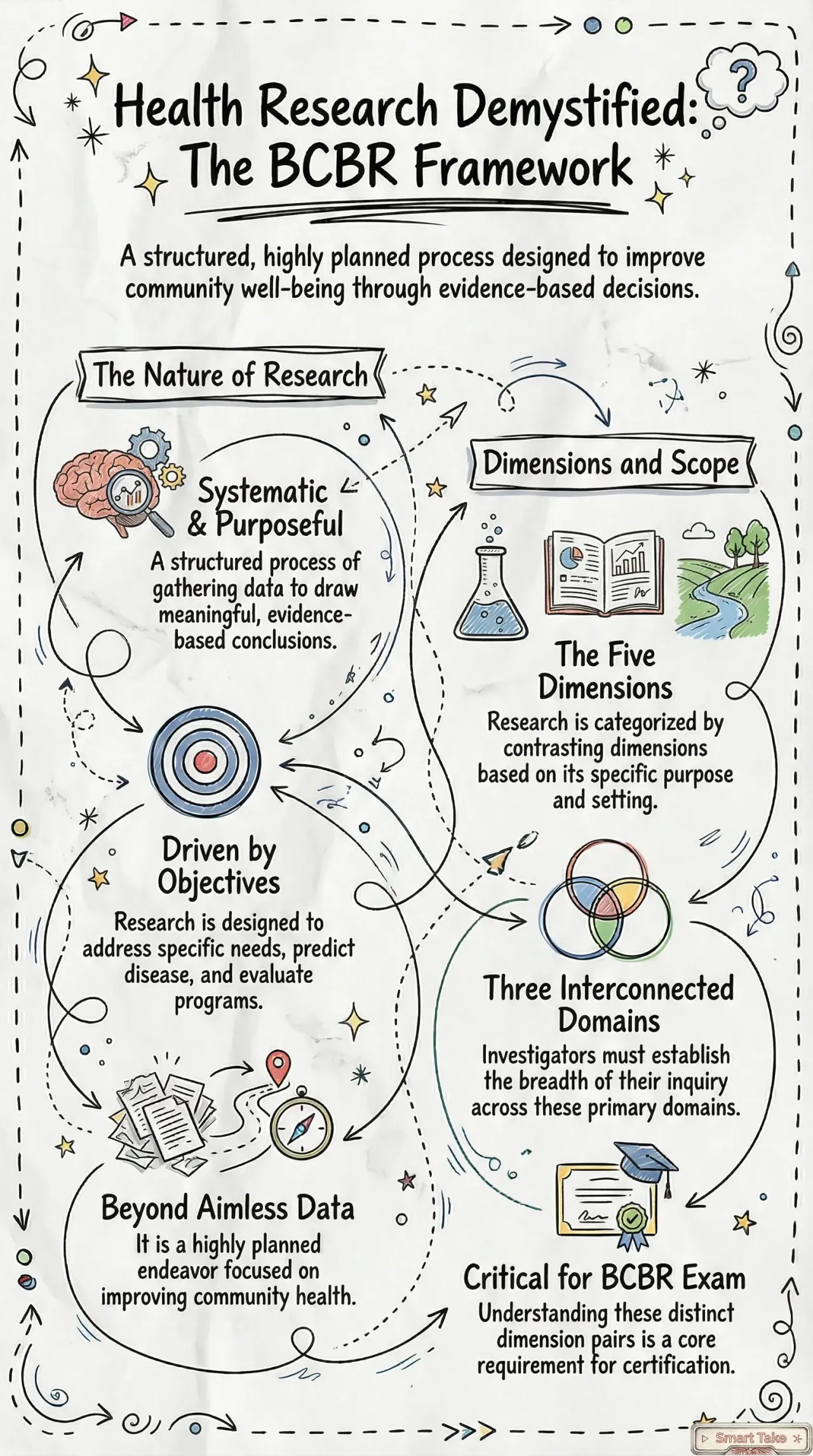
Health research is a highly structured and systematic process of data collection designed to inform evidence-based decisions and improve community well-being. The breadth of health research encompasses three interconnected domains: the human host, the environment and society, and the healthcare infrastructure. To effectively design a study, investigators must understand the five contrasting dimensions of research (Theoretical vs. Applied, Preventive vs. Therapeutic, Bench vs. Bedside, Exploratory vs. Confirmatory, and Translational vs. Implementation). Ultimately, the overarching scope of any health research project is defined by its core objective, whether that is discovering new information, verifying existing data locally, establishing cause-and-effect relationships, testing new clinical interventions, or evaluating ongoing public health programs.
Key points
- Systematic Process: Health research is highly planned and structured, aimed at making evidence-based decisions to improve health.
- Three Domains of Inquiry: Research spans the Human Host, the Environment/Society, and Health Care Infrastructure.
- Five Dimensional Pairs: Research is categorized into contrasting pairs (e.g., Theoretical vs. Applied, Bench vs. Bedside) depending on its setting and purpose.
- Translational vs. Implementation: Translational moves discoveries from the lab to clinical use ("bench to bedside"); Implementation focuses on integrating those discoveries into real-world healthcare systems.
- Core Objectives: The scope of research aims to get new info, verify existing info, explain cause-and-effect, test interventions, or evaluate programs.
1. Introduction to Health Research
- Definition & Nature: A systematic, highly planned, and structured process of gathering data.
- Purpose:
- Draw meaningful conclusions.
- Make evidence-based decisions.
- Improve community health and well-being.
- Address specific health needs and predict disease occurrences.
- Evaluate programmatic interventions.
2. The Domains of Inquiry (Breadth and Depth)
Before conducting a study, investigators must identify their domain of inquiry:
- The Human Host: Studying individuals across all health states (healthy, susceptible, actively diseased, or deceased).
- The Environment and Society: Investigating external, non-clinical factors that influence health.
- Examples: Climatic conditions, housing, vectors, animals, socio-cultural practices, and family structures.
- Health Care Infrastructure: Evaluating the systems that provide care.
- Focus areas: Delivery, accessibility, and efficacy of health services.
3. The Five Dimensions of Health Research
Research is categorized across distinct, contrasting dimensions based on setting and purpose. (High yield for BCBR exam):
- Theoretical vs. Applied Research
- Theoretical (Basic): Curiosity-driven; generates new knowledge without an immediate practical application (e.g., studying the genetic sequence of a new virus).
- Applied: Uses existing knowledge to solve practical, real-world problems (e.g., developing a vaccine from that genetic sequence).
- Preventive vs. Therapeutic Research
- Preventive: Interventions to stop disease occurrence (e.g., trials for a new malaria prophylactic).
- Therapeutic: Interventions to treat or cure an existing disease (e.g., testing a new chemotherapy drug).
- Bench-based vs. Bedside Research
- Bench-based: Highly controlled laboratory settings (e.g., in-vitro models, animal subjects).
- Bedside (Clinical): Direct interaction with human patients in clinical settings to observe disease or test treatments.
- Exploratory vs. Confirmatory Research
- Exploratory: Investigates a poorly understood phenomenon to form hypotheses (e.g., identifying a novel cluster of respiratory illnesses).
- Confirmatory: Tests a specific, pre-defined hypothesis to verify information (e.g., a large-scale trial to confirm if a specific drug caused that illness).
- Translational vs. Implementation Research
- Translational: Bridges the gap from basic science to clinical application ("bench to bedside"). Example: Writing the core machine-learning algorithm for a medical app like Vitalis.
- Implementation: Studies how to integrate evidence-based interventions into real-world systems. Example: Evaluating how effectively clinical staff adopt and use the Vitalis app in a rural clinic.
4. The Broad Scope of Health Research (Objectives)
The overarching scope aligns with one of the following primary goals:
- Getting new information: Discovering unknown facts (e.g., identifying structural differences between Hepatitis B and Hepatitis E).
- Verifying available information: Confirming if global data applies to local settings (e.g., checking if pediatric pneumonia causes in developed nations match those in resource-limited areas).
- Explaining cause-and-effect relationships: Determining if a specific exposure causes a specific outcome (e.g., does receiving a breast implant increase the risk of specific cancers?).
- Testing new interventions: Evaluating the efficacy and safety of new drugs, vaccines, or diagnostic tools.
- Evaluating ongoing programs: Assessing the operational feasibility and success of current initiatives (e.g., determining if a national surveillance program successfully predicts influenza outbreaks).