BCBR
Topic 01 · Introduction to health research
The research life cycle and review processes
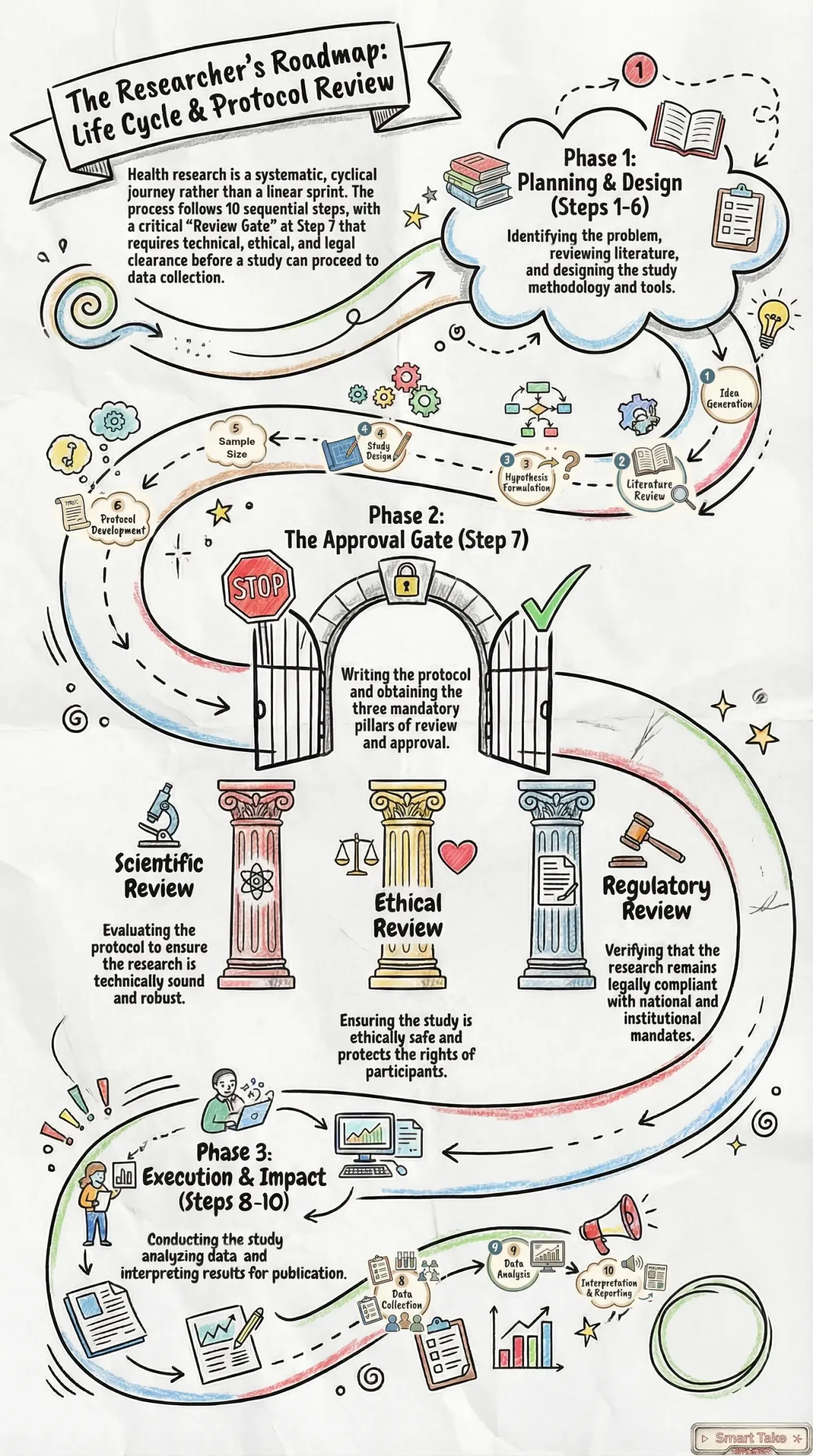
Conducting health research is a systematic, 10-step cyclical process where the outcome of one study builds the foundation for the next. Step 7 is crucial, requiring a written protocol to pass three mandatory reviews (Scientific, Ethical, and Regulatory) to ensure technical merit, participant safety, and legal compliance before any data collection begins.
Key points
- Research is a cyclical, 10-step systematic process.
- Step 7 (Protocol & Approvals) is an absolute prerequisite; no data collection can start without clearance.
- Scientific Review ensures technical validity; scientifically flawed studies are inherently unethical.
- Ethical Review safeguards participant well-being and mandates documented informed consent via IEC.
- Regulatory Review (CDSCO/DCGI) is mandatory for clinical trials (new drugs/devices/vaccines).
- Prospective registration with CTRI is a legal requirement in India before enrolling the first trial participant.
The 10 Steps of the Research Life Cycle
- Identify the Research Problem: Recognize knowledge gaps or specific health issues requiring investigation.
- Review of Literature: Systematically search databases (e.g., PubMed) to understand existing evidence and avoid duplicating past efforts.
- Formulate the Hypothesis and Objectives: Define what the study intends to prove/disprove (hypothesis) and map out primary and secondary goals (objectives).
- Choose the Study Design: Select the appropriate epidemiological framework (e.g., cross-sectional, case-control, cohort, randomized controlled trial) to answer the research question.
- Decide the Study Population and Sample Size: Define inclusion/exclusion criteria and calculate the exact participant number needed for statistical power.
- Design Data Collection Tools: Create and validate questionnaires, case record forms (CRFs), or laboratory protocols.
- Write the Protocol and Obtain Approvals: Draft the comprehensive study rulebook and submit for mandatory peer and regulatory reviews. (No data collection can begin before clearance).
- Conduct the Study and Collect Data: Execute the protocol in the field/clinical setting, strictly adhering to quality control and ethical guidelines.
- Manage and Analyze Data: Enter raw data into secure databases, clean for errors, and apply statistical tests to find meaningful patterns.
- Interpret and Publish Results: Draw clinical conclusions from statistical data and disseminate findings via peer-reviewed journals, policy briefs, or conferences.
The Three Pillars of Protocol Review (Step 7)
1. Scientific Review
- Reviewing Body: Scientific Advisory Committee (SAC) or departmental review board (subject-matter experts).
- Focus: Evaluates the technical merit of the study.
- Key Questions: Is the study design appropriate? Is the sample size mathematically correct? Are objectives achievable?
- Core Principle: If the science is flawed, ethics are automatically compromised (it is unethical to subject humans to poorly designed studies).
2. Ethical Review
- Reviewing Body: Institutional Ethics Committee (IEC).
- Framework: ICMR National Ethical Guidelines.
- Primary Mandate: Protect the safety, dignity, and well-being of research participants.
- Key Focus: Meticulous review of the informed consent process to ensure participants understand risks and benefits.
- Crucial Rule: No human research can commence without documented, written clearance from an IEC.
3. Regulatory Review
- Applicability: Clinical trials involving new drugs, vaccines, medical devices, or new indications for existing drugs.
- Reviewing Body (India): Central Drugs Standard Control Organisation (CDSCO), headed by the Drugs Controller General of India (DCGI).
- Crucial Rule: All clinical trials in India must be prospectively registered with the Clinical Trials Registry - India (CTRI) before the first participant is enrolled.