BCBR
Sourcing literature and search strategies
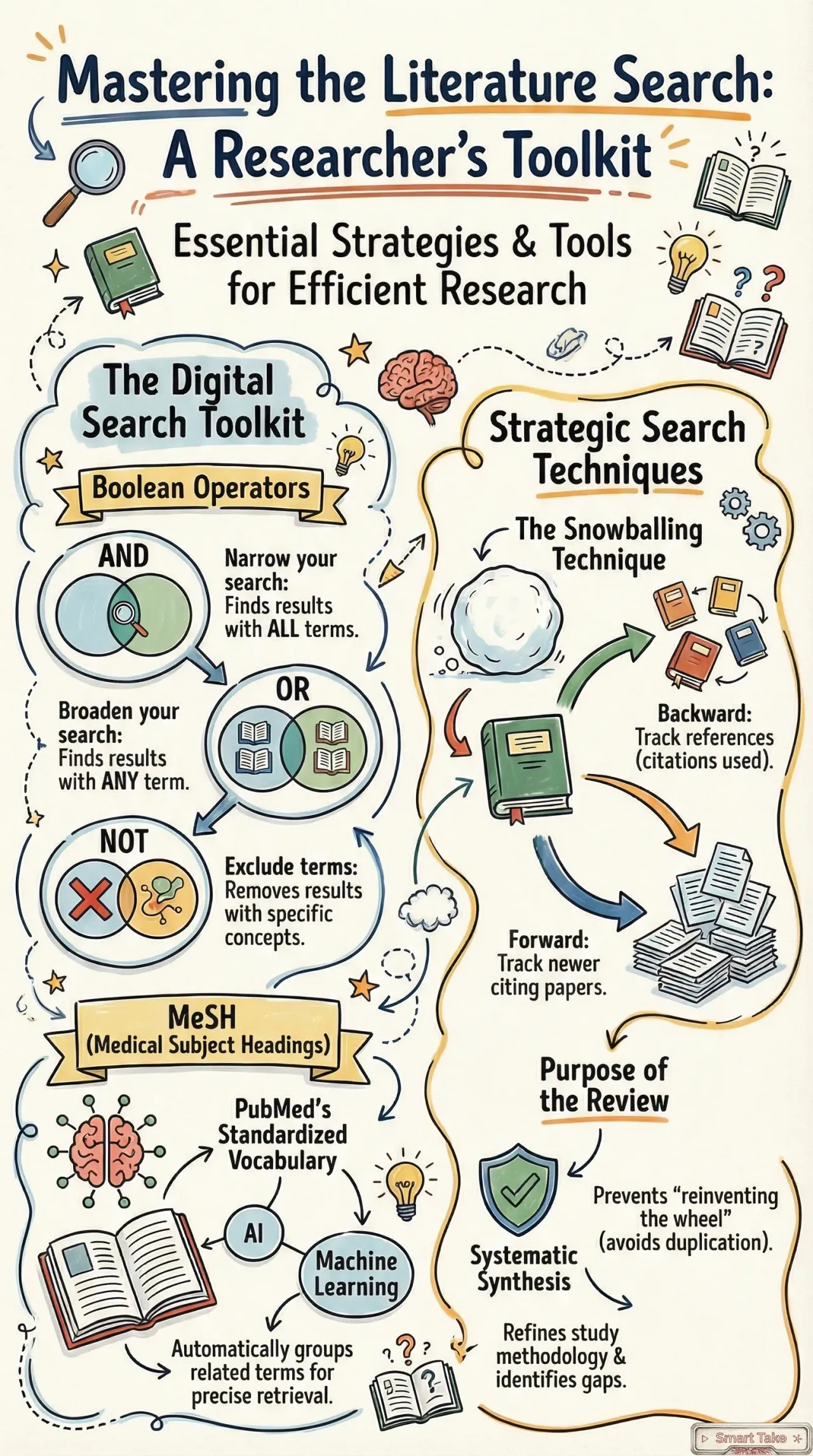
This topic focuses on the systematic process of sourcing literature and implementing effective search strategies for biomedical research. A literature review is a critical synthesis of existing knowledge that prevents research duplication, identifies knowledge gaps, and refines study methodologies. The content establishes a hierarchy of information sources ranging from original primary data to broad tertiary overviews. Furthermore, it outlines technical search competencies, including the application of Boolean operators (AND, OR, NOT), the use of PubMed's Medical Subject Headings (MeSH) for standardized indexing, and the 'snowballing' technique for expanding literature discovery through citation tracking.
Key points
- Purpose: Critical synthesis of knowledge, identifying research gaps, and refining methodology.
- Source Hierarchy: Primary (original research), Secondary (synthesized reviews), and Tertiary (textbooks/background).
- Boolean Operators: Tools to narrow (AND), broaden (OR), or exclude (NOT) search results.
- MeSH Terms: PubMed's controlled vocabulary that standardizes terminology for comprehensive searching.
- Snowballing: A dual-directional strategy using a single relevant paper to find older (backward) and newer (forward) citations.
1. The Purpose of Literature Review
- Definition: A critical, systematic synthesis of existing knowledge (not just a summary).
- Objectives:
- Prevents "reinvention of the wheel" (avoiding duplicate research).
- Identifies gaps in current literature.
- Refines the methodology for the proposed study.
2. Hierarchy of Literature Sources
- Primary Sources:
- Original, peer-reviewed research articles.
- Reports raw data and first-hand findings for the first time.
- Example: Original clinical trial papers.
- Secondary Sources:
- Documents that synthesize, summarize, or analyze primary research.
- Includes: Review articles, systematic reviews, meta-analyses, and clinical guidelines.
- Tertiary Sources:
- Broad overviews providing general background.
- Includes: Textbooks and encyclopedias.
- Note: Generally not cited as primary evidence in a research protocol.
3. Search Strategies and Syntax
- Boolean Operators:
- AND: Narrows the search; requires both terms to be present (e.g., "AI" AND "Diagnostics").
- OR: Broadens the search; allows either term to be present; ideal for synonyms (e.g., "App" OR "Software").
- NOT: Excludes a term; must be used with caution to avoid filtering relevant data (e.g., "AI" NOT "Radiology").
- MeSH Terms (Medical Subject Headings):
- Standardized controlled vocabulary used by PubMed.
- Categorizes articles under uniform headings regardless of the author's specific keywords.
- Ensures comprehensive retrieval (e.g., searching "Artificial Intelligence" captures "Machine Learning" and "Neural Networks").
4. The Snowballing Technique
- Concept: Using a highly relevant "seed" paper to expand the search.
- Backward Snowballing: Reviewing the reference list of the paper to find older, foundational research.
- Forward Snowballing: Identifying newer papers that have cited the original paper since its publication.