BCBR
Critical appraisal and information management
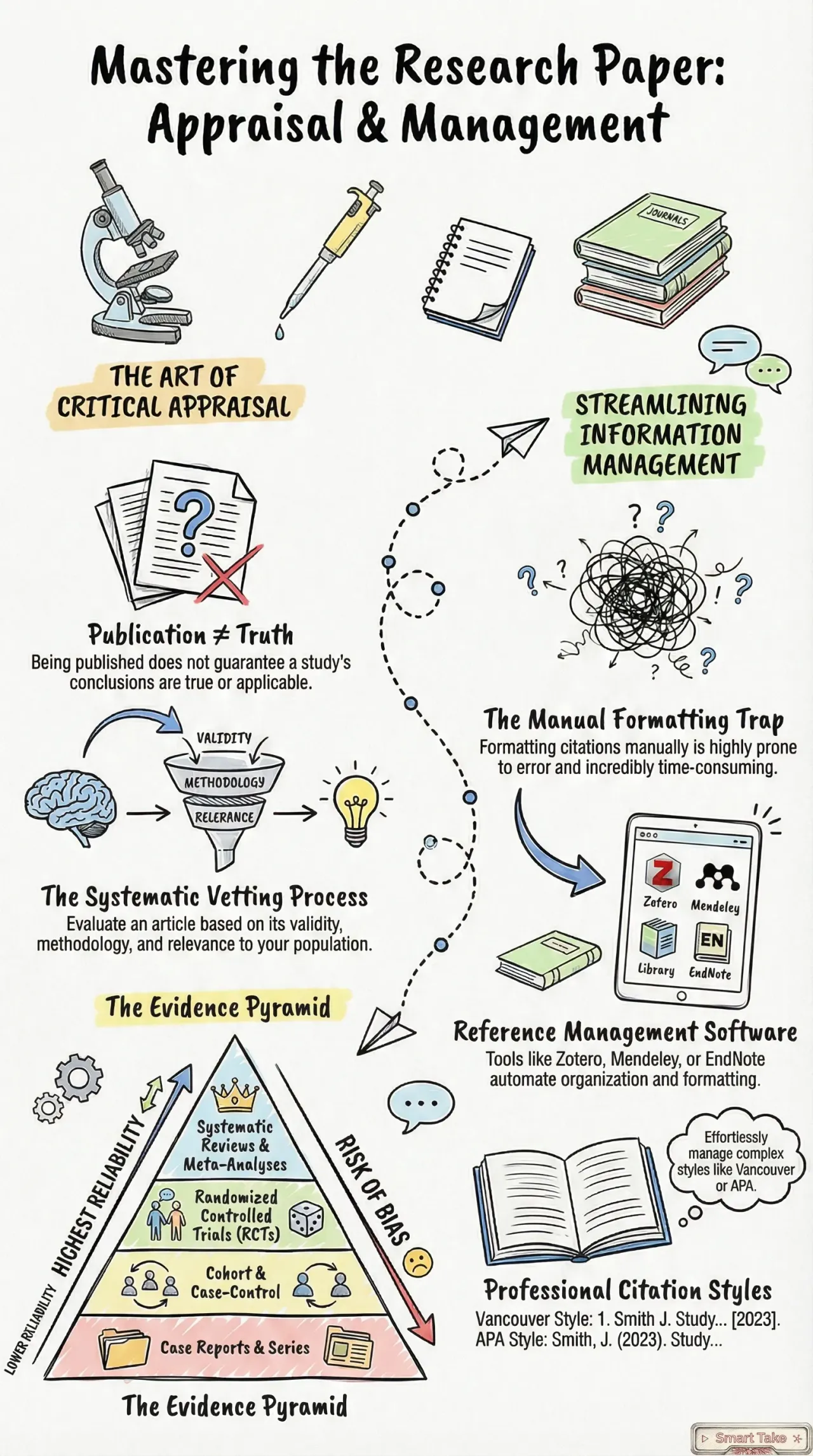
Critical Appraisal and Information Management are foundational pillars of the Biomedical Research process. Critical appraisal ensures that published research is systematically evaluated for validity, methodology, and clinical relevance rather than being accepted at face value. This process relies on the Hierarchy of Evidence, which ranks study designs from high-level syntheses like Meta-Analyses to lower-level Expert Opinions. Effective research also requires navigating publishing ethics, specifically avoiding predatory journals and plagiarism, while utilizing Reference Management Software (RMS) to handle the technical complexities of citations and bibliography organization.
Key points
- Critical Appraisal: A systematic process to evaluate the validity and applicability of research studies.
- Hierarchy of Evidence: A pyramid ranking reliability, with Systematic Reviews at the top and Expert Opinion at the base.
- Publishing Ethics: Researchers must identify predatory journals and strictly avoid all forms of plagiarism.
- Reference Management: Essential for error-free citation, metadata storage, and automated bibliography generation.
- Tools: Software like Zotero, Mendeley, and EndNote are the industry standards for information management.
1. The Necessity of Critical Appraisal
- Purpose: To determine if an article's conclusions are true, unbiased, and applicable to a specific patient population.
- Evaluation Criteria:
- Appropriateness of study design.
- Control of potential biases.
- Strength and accuracy of statistical analysis.
- Relevance of findings to the researcher's own context.
2. The Hierarchy of Evidence (Highest to Lowest)
- Systematic Reviews & Meta-Analyses: The 'Gold Standard'; rigorous synthesis of high-quality trials.
- Randomized Controlled Trials (RCTs): Experimental studies with tight controls and minimal bias.
- Cohort Studies: Observational studies following a group forward over time.
- Case-Control Studies: Observational studies looking backward from a disease/outcome.
- Cross-Sectional Studies & Surveys: A snapshot of a population at a single point in time.
- Case Reports & Case Series: Observations of single patients or small groups.
- Expert Opinion: The lowest tier; based on experience rather than empirical data.
3. Navigating Publishing Pitfalls
- Predatory Journals:
- Open-access models focusing on high fees rather than peer-review rigor.
- Lack editorial standards; citing them undermines the credibility of new research.
- Plagiarism:
- Presenting others' work, ideas, or data as your own without citation.
- Self-Plagiarism: Reusing one’s own previously published work without disclosure.
4. Information Management Tools
- Problem: Manual formatting (Vancouver, APA) is time-consuming and error-prone.
- Solution: Reference Management Software (e.g., Zotero, Mendeley, EndNote).
- Core Functions:
- Capture: Save PDFs and metadata directly from web browsers.
- Organization: Store papers in project-specific folders.
- Automation: Generate in-text citations and bibliographies in Word/Google Docs.
- Flexibility: Instantly change citation styles based on journal requirements.