BCBR
Topic 10 · Measurement of study variables
Types of variables and data
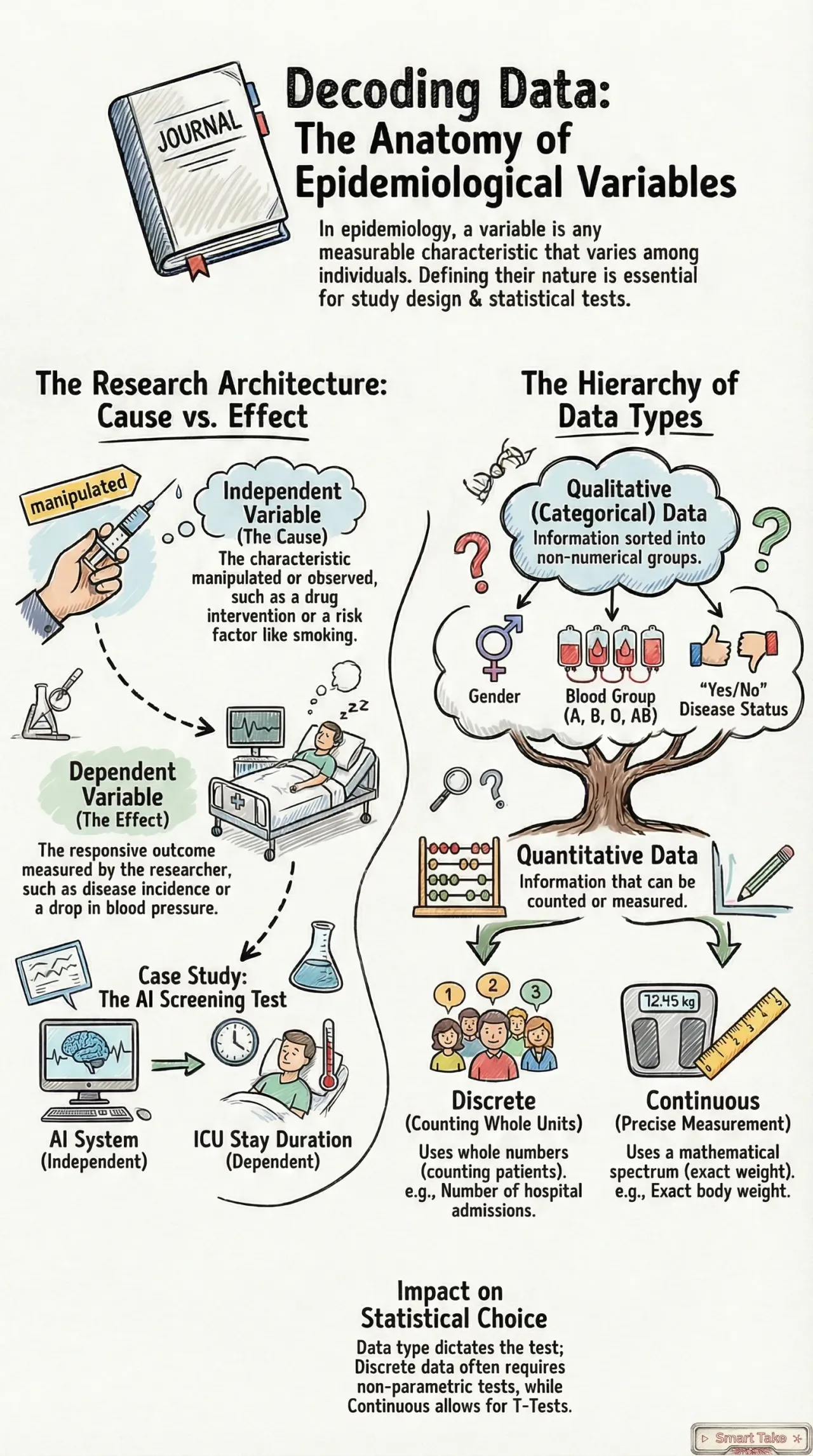
This module covers the fundamental concepts of variables and data types within the context of the Basic Course in Biomedical Research (BCBR). It defines a variable as any measurable characteristic that varies among individuals, such as demographics or clinical outcomes. The text distinguishes between independent variables (predictors/exposures) and dependent variables (outcomes/effects). Furthermore, it classifies epidemiological data into qualitative (categorical) and quantitative (numerical) types, with the latter subdivided into discrete (counted whole numbers) and continuous (measured values on a scale). Accurate identification of these variables is presented as a prerequisite for appropriate study design and statistical analysis.
Key points
- Variable Definition: Any quantifiable characteristic, number, or quantity that varies across a population.
- Independent Variable: The presumed 'cause,' intervention, or risk factor being studied.
- Dependent Variable: The 'effect' or clinical outcome measured in response to the independent variable.
- Qualitative Data: Categorical variables based on types or attributes (e.g., Blood Group, Gender).
- Quantitative Data: Numerical variables, categorized as either Discrete (whole counts) or Continuous (precise measurements).
- Statistical Significance: The type of data (discrete vs. continuous) dictates the choice of statistical tests (e.g., T-Tests vs. Non-parametric tests).
1. Definition of a Variable
- In epidemiology, a variable is any characteristic, number, or quantity that can be measured or quantified.
- It must vary from one individual to another within a chosen population.
- Examples:
- Demographics: Age, height.
- Laboratory values: Blood pressure, fasting glucose.
- Outcomes: Survival status, disease presence.
2. Variable Roles in Research
- Independent Variable (Predictor/Exposure):
- The characteristic manipulated or observed.
- Represents the presumed "cause."
- In observational studies: Referred to as the risk factor (e.g., smoking).
- In experimental trials: Referred to as the intervention (e.g., a new drug).
- Dependent Variable (Outcome):
- The responsive variable representing the "effect."
- The disease status or health outcome being tracked (e.g., lung cancer incidence).
3. Classification of Epidemiological Data
- Qualitative (Categorical) Variables:
- Based on categories rather than numerical amounts.
- Examples: Gender, Blood Group (A, B, O), Disease status (Yes/No).
- Quantitative (Numerical) Variables:
- Discrete Variables:
- Take only whole numerical values.
- Usually generated by counting.
- Examples: Number of pregnancies, number of hospital admissions, heart rate (beats per minute).
- Continuous Variables:
- Can take any value within a range.
- Restricted only by the precision of the measuring instrument.
- Examples: Body weight (72.45 kg), height, biomarker concentrations.
- Discrete Variables:
4. Practical Application & Study Design
- Confounding Variables: Factors other than the independent variable that may affect the outcome (e.g., baseline disease severity, concurrent medication).
- Statistical Impact:
- Discrete Variables: Often require non-parametric testing or logistic regression.
- Continuous Variables: Allow for powerful parametric models such as T-Tests or ANOVA.
- Critical Step: Identifying the data type is the first step in selecting the correct statistical model and ensuring robust study design.