BCBR
Topic 10 · Measurement of study variables
Scales of measurement, reliability and validity
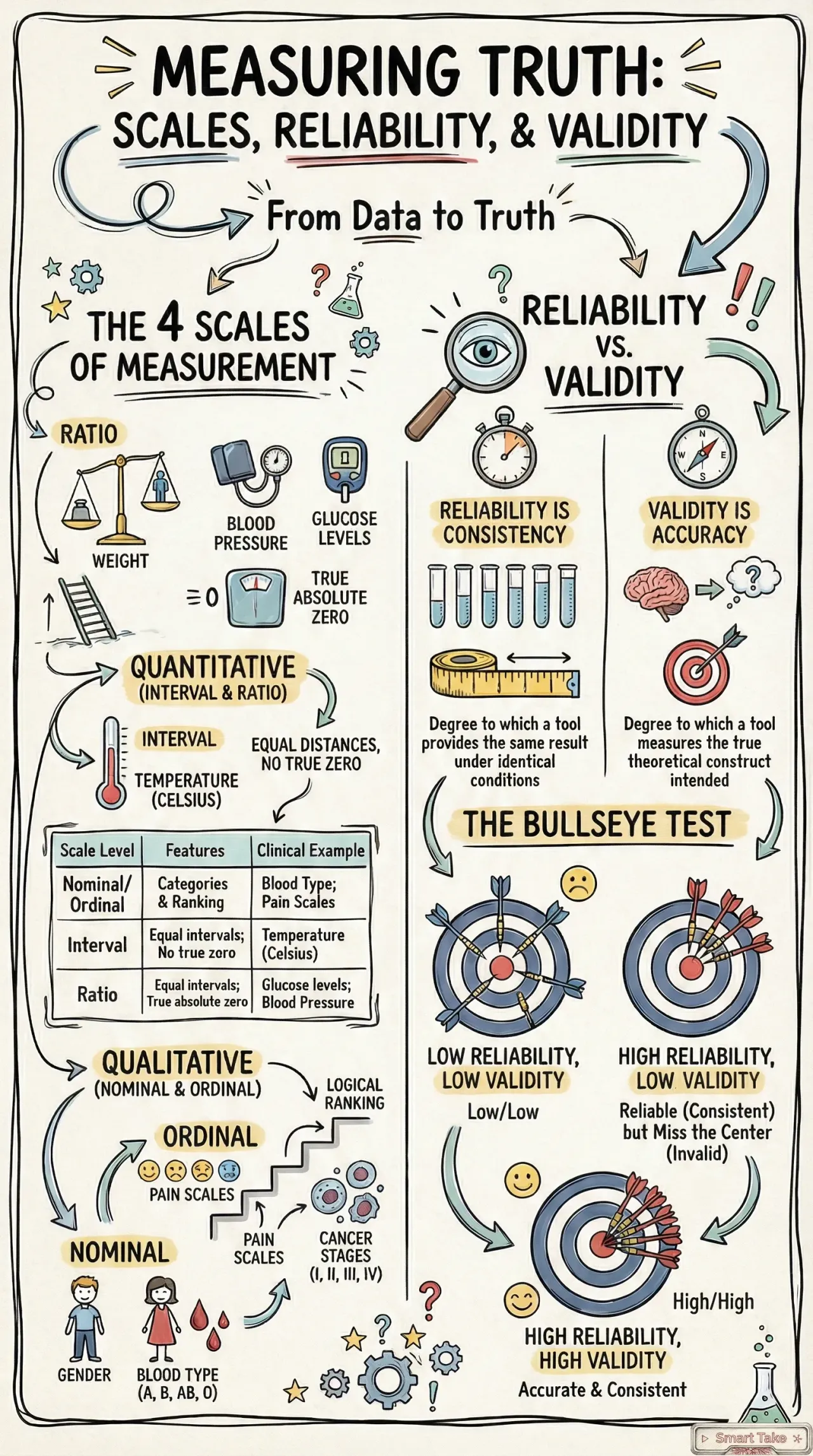
This module outlines the fundamental principles of data measurement and the evaluation of measurement instruments within biomedical research. Data is categorized into a hierarchy of four scales, Nominal, Ordinal, Interval, and Ratio, each determining the level of mathematical operation possible. Furthermore, the quality of clinical research depends on two critical parameters: Reliability (the consistency and precision of repeated measurements) and Validity (the accuracy and truthfulness of the measurement relative to the actual value). Understanding the relationship between these two is vital for minimizing systematic error and bias in clinical trials.
Key points
- Scales of Measurement: Data is organized into a four-level hierarchy (Nominal < Ordinal < Interval < Ratio).
- Nominal: Categorical classification with no inherent mathematical order.
- Ordinal: Ranked categories where the distance between levels is unknown/unequal.
- Interval: Ordered data with equal distances between points but an arbitrary zero.
- Ratio: Highest level of data featuring equal intervals and an absolute (true) zero.
- Reliability: Synonymous with precision and consistency; the ability to replicate results.
- Validity: Synonymous with accuracy; the degree to which a tool measures the intended true value.
- The Relationship: A tool can be highly reliable (consistent) while being completely invalid (inaccurate due to systematic bias).
1. The Four Scales of Measurement
- Nominal Scale
- Simplest level of measurement.
- Classifies data into mutually exclusive categories.
- No mathematical order or logical ranking.
- Examples: Gender, Blood Type, Geographic location, Disease presence (Yes/No).
- Ordinal Scale
- Categories possess a clear logical or hierarchical order.
- The exact distance/magnitude between categories is unknown or subjective.
- Examples: Cancer staging (Stage I-IV), Pain Scales (Mild, Moderate, Severe).
- Interval Scale
- Ordered data where the distance between any two intervals is equal and known.
- Features an arbitrary zero point (zero does not mean absence of the variable).
- Example: Temperature in Celsius (0°C does not mean 'no heat').
- Ratio Scale
- Highest form of measurement.
- Ordered data with precisely equal intervals.
- Features a true absolute zero point.
- Allows for meaningful ratios (e.g., 100kg is exactly twice 50kg).
- Examples: Weight, Height, Biochemical lab values (e.g., Blood glucose).
2. Reliability vs. Validity
- Reliability (Precision)
- Defines the degree of consistency.
- Answers: Does the tool give the same result under identical conditions repeatedly?
- Validity (Accuracy)
- Defines the degree of absolute truthfulness.
- Answers: Does the tool measure the true theoretical construct it is designed to measure?
3. The Bullseye Analogy
- Low Reliability, Low Validity: Darts are scattered randomly across the board.
- High Reliability, Low Validity: Darts are clustered tightly together (consistent) but far from the center (inaccurate). This represents Systematic Error.
- High Reliability, High Validity: Darts are tightly clustered in the absolute center (the truth).
4. Clinical Application & Bias
- A tool can be perfectly consistent but fundamentally wrong due to miscalibration.
- Example: A digital sphygmomanometer that reads the exact same value 10 times (High Reliability) but is 15 mmHg off from the true value (Low Validity).
- This discrepancy leads to Measurement Bias, where the consistency of the tool masks its inaccuracy.