BCBR
Topic 04 · Measures of disease frequency
Incidence and prevalence
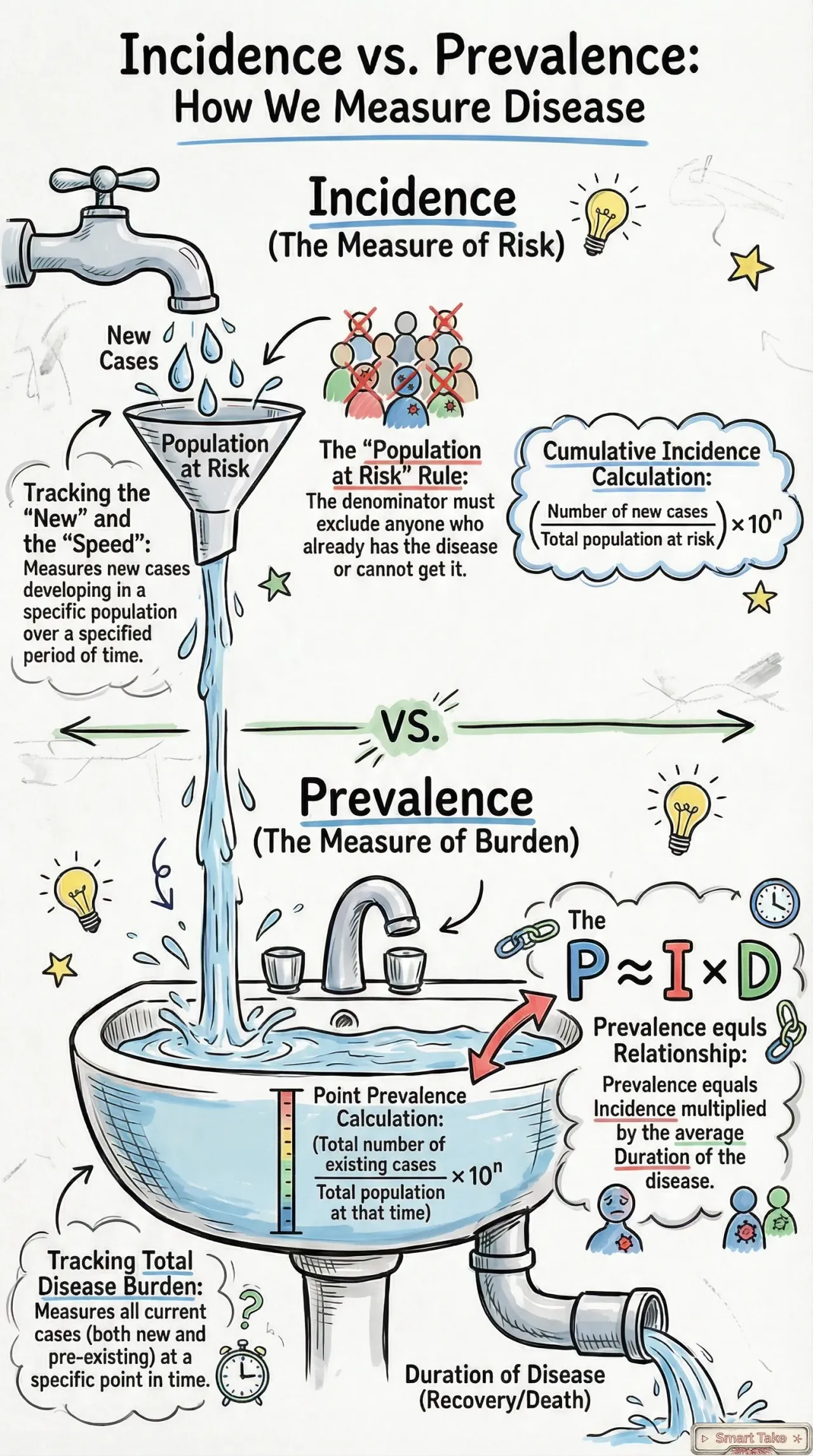
This module covers the fundamental epidemiological measures used to quantify disease frequency: Incidence and Prevalence. Incidence focuses on the occurrence of new cases, serving as a direct measure of risk and the speed of disease spread within a population at risk. Prevalence reflects the total burden of a disease by accounting for all existing cases (new and pre-existing) at a specific point in time. The relationship between these two metrics is primarily governed by the duration of the illness, expressed mathematically as . Understanding these measures is critical for assessing public health impact, allocating resources, and identifying the speed of transmission versus the chronic nature of various health conditions.
Key points
- Incidence: Measures the risk and speed of new disease development over a specified period.
- Prevalence: Measures the total burden of disease (all current cases) at a specific point in time.
- Population at Risk: The denominator for incidence; must exclude those who already have the disease or are biologically incapable of getting it.
- Fundamental Relationship: Prevalence is approximately the product of Incidence and average Duration .
- Chronic vs. Acute: Chronic diseases have high prevalence due to long duration; acute or highly fatal diseases have low prevalence due to short duration.
Try it
Prevalence ≈ incidence × duration = 100 per 1,000
1. Incidence (The Measure of Risk)
-
Definition: The number of new cases of a disease that develop in a specific population during a defined time period.
-
Utility: It indicates the probability or 'risk' of an individual in the population developing the disease.
-
Formula (Cumulative Incidence):
-
Denominator Rules:
- Only include the "population at risk."
- Exclude: Individuals who already have the disease at the start of the study.
- Exclude: Individuals who are biologically incapable of contracting the disease (e.g., excluding men from studies on cervical cancer).
2. Prevalence (The Measure of Burden)
-
Definition: The total number of all current cases (both new and pre-existing) in a specific population at a specific point in time.
-
Utility: It measures the "burden" of disease on the healthcare system and society.
-
Formula (Point Prevalence):
3. The Mathematical Relationship
- Formula:
- Variables:
- = Prevalence
- = Incidence
- = Average Duration of the disease
- Dynamics of Change:
- If Incidence increases, Prevalence increases.
- If Duration increases (e.g., better life-prolonging treatment but no cure), Prevalence increases.
- If Duration decreases (e.g., faster recovery or higher fatality), Prevalence decreases.
4. Real-World Application Examples
- Chronic Diseases (e.g., Type 2 Diabetes):
- Stable Incidence + Long Duration = Very High Prevalence.
- Acute Diseases (e.g., Common Cold):
- High Incidence + Short Duration = Low Point Prevalence (on any given day).
- Fatal Diseases (e.g., Rabies):
- Short Duration (due to rapid mortality) = Prevalence near zero, regardless of the number of incident cases.