BCBR
Topic 04 · Measures of disease frequency
Ratios, proportions and rates
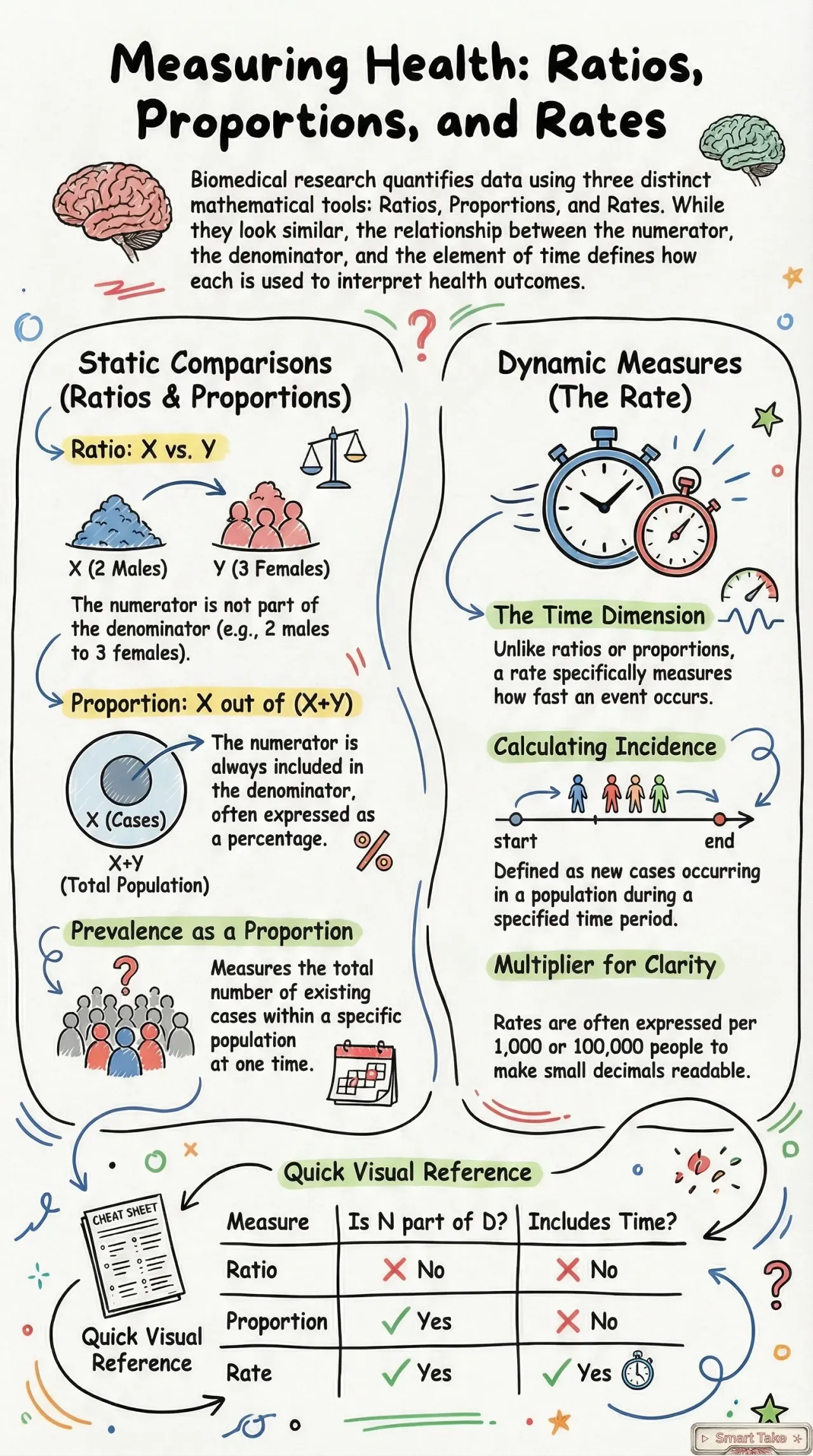
This module covers the three fundamental mathematical tools used in epidemiology to measure disease frequency: Ratios, Proportions, and Rates. These tools are essential for expressing incidence and prevalence. The primary distinction between them lies in the relationship between the numerator and the denominator, and whether the dimension of time is incorporated into the measurement.
Key points
- Ratio: Compares two independent quantities where the numerator is not part of the denominator
- Proportion: A fraction where the numerator is included in the denominator typically expressed as a percentage.
- Rate: A measure of the frequency of an event in a defined population over a specific period of time.
- Prevalence: Categorized as a Proportion.
- Incidence: Categorized as a Rate.
1. Ratio
- Definition: Expresses the relationship between two distinct, non-overlapping numbers.
- The Rule: The numerator is not included in the denominator .
- Formula: or
- Examples:
- Sex Ratio: Male patients vs. Female patients (e.g., 40:20).
- Maternal Mortality Ratio (MMR): Number of maternal deaths compared to the number of live births.
2. Proportion
- Definition: A specific type of ratio that indicates the relation of a part to the whole.
- The Rule: The numerator is included in the denominator .
- Formula:
- Characteristics:
- Always ranges between 0 and 1 (or 0% to 100%).
- Prevalence is always expressed as a proportion.
- Example: 20 diabetic patients out of a total of 100 patients = 20%.
3. Rate
- Definition: A measure of the speed or frequency with which an event happens in a population over time.
- The Rule: It must include a specific time period and the population at risk.
- Formula:
- Characteristics:
- Time is the critical differentiator.
- Incidence is usually expressed as a rate.
- Example: The incidence rate of Tuberculosis in India during the year 2025.