BCBR
Peer review and authorship
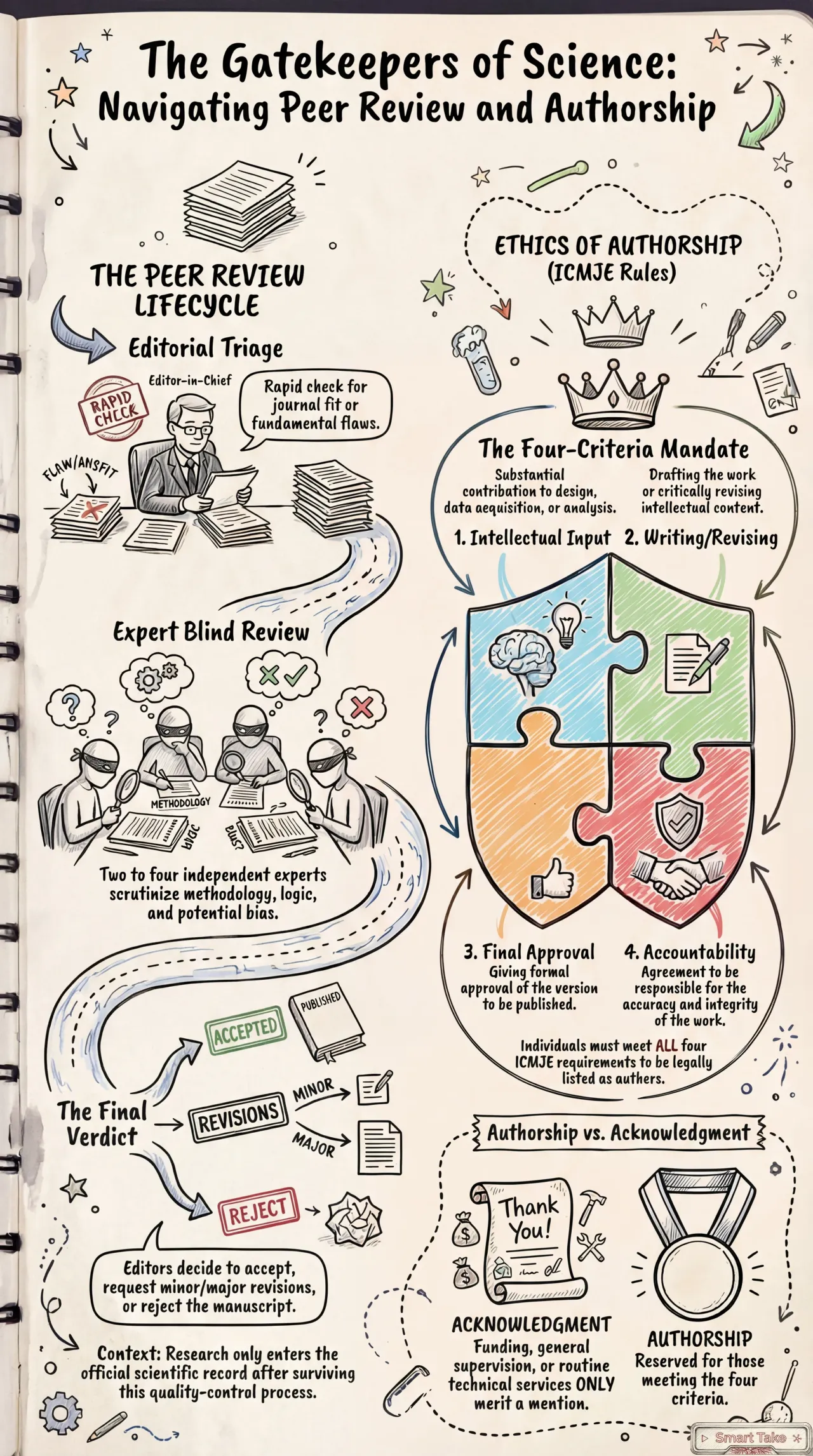
Peer review and authorship guidelines serve as the essential quality control and ethical framework of scientific research. The peer review process involves a rigorous, multi-stage evaluation, including editorial triage and expert assessment, to ensure methodological soundness and novelty before a manuscript enters the official scientific record. Complementing this, the International Committee of Medical Journal Editors (ICMJE) provides strict criteria for authorship to prevent unethical practices like gift or ghost authorship. These standards ensure that only those who have made significant intellectual contributions, participated in drafting/revising, provided final approval, and accepted full accountability are credited as authors, while others are appropriately recognized in the acknowledgments.
Key points
- Peer Review: The primary quality-control mechanism for validating methodology, ethics, and novelty in science.
- Editorial Triage: Initial screening by the Editor-in-Chief to determine if a paper fits the journal scope or should be 'Desk Rejected'.
- Review Models: Includes single-blind (reviewers known to authors) and double-blind (both parties anonymized) systems.
- Reviewer Decisions: Outcomes range from Acceptance and Revisions (Minor/Major) to Rejection.
- ICMJE Criteria: Four mandatory requirements that must all be met to qualify for authorship.
- Authorship vs. Acknowledgment: Distinction based on the depth of intellectual contribution; administrative or technical support only merits acknowledgment.
1. The Peer Review Process
- Definition: A scrutiny process that research must survive to enter the official scientific record.
- Lifecycle of a Manuscript:
- Editorial Triage: Rapid decision by Editor-in-Chief; results in either proceeding to review or 'Desk Rejection'.
- Blind Review: Manuscript sent to 2–4 independent experts (Peers).
- Single-blind: Reviewers know author identities; authors do not know reviewers.
- Double-blind: Both authors and reviewers remain anonymous to each other.
- Reviewer Assessment: Focuses on literature review, methodology, statistical analysis, and conclusions to find bias or flaws.
- The Decision:
- Accept: Extremely rare on the first submission.
- Accept with Minor/Major Revisions: The most frequent path to publication.
- Reject: Requires authors to submit to a different journal.
2. ICMJE Authorship Criteria
To be listed as an author, an individual must meet ALL four of the following:
- Substantial Contributions: To the conception/design of the work OR the acquisition, analysis, or interpretation of data.
- Drafting or Revising: Drafting the work or revising it critically for important intellectual content.
- Final Approval: Providing final approval of the version to be published.
- Accountability: Agreement to be accountable for all aspects of the work, ensuring accuracy and integrity are investigated and resolved.
3. Ethical Issues in Authorship
- Gift Authorship: Including individuals (e.g., department heads) who did no work.
- Ghost Authorship: Using industry writers to mask their involvement without credit.
4. Acknowledgment Guidelines
Individuals who do not meet all four ICMJE criteria are listed in the Acknowledgments section. This includes:
- Securing lab funding.
- General supervision or providing lab space (e.g., Department Chair).
- Administrative support or patient recruitment.
- Routine technical services (e.g., lab technicians performing standard assays without data interpretation).
- Writing assistance, technical editing, or language editing.