BCBR
Reporting guidelines for medical research
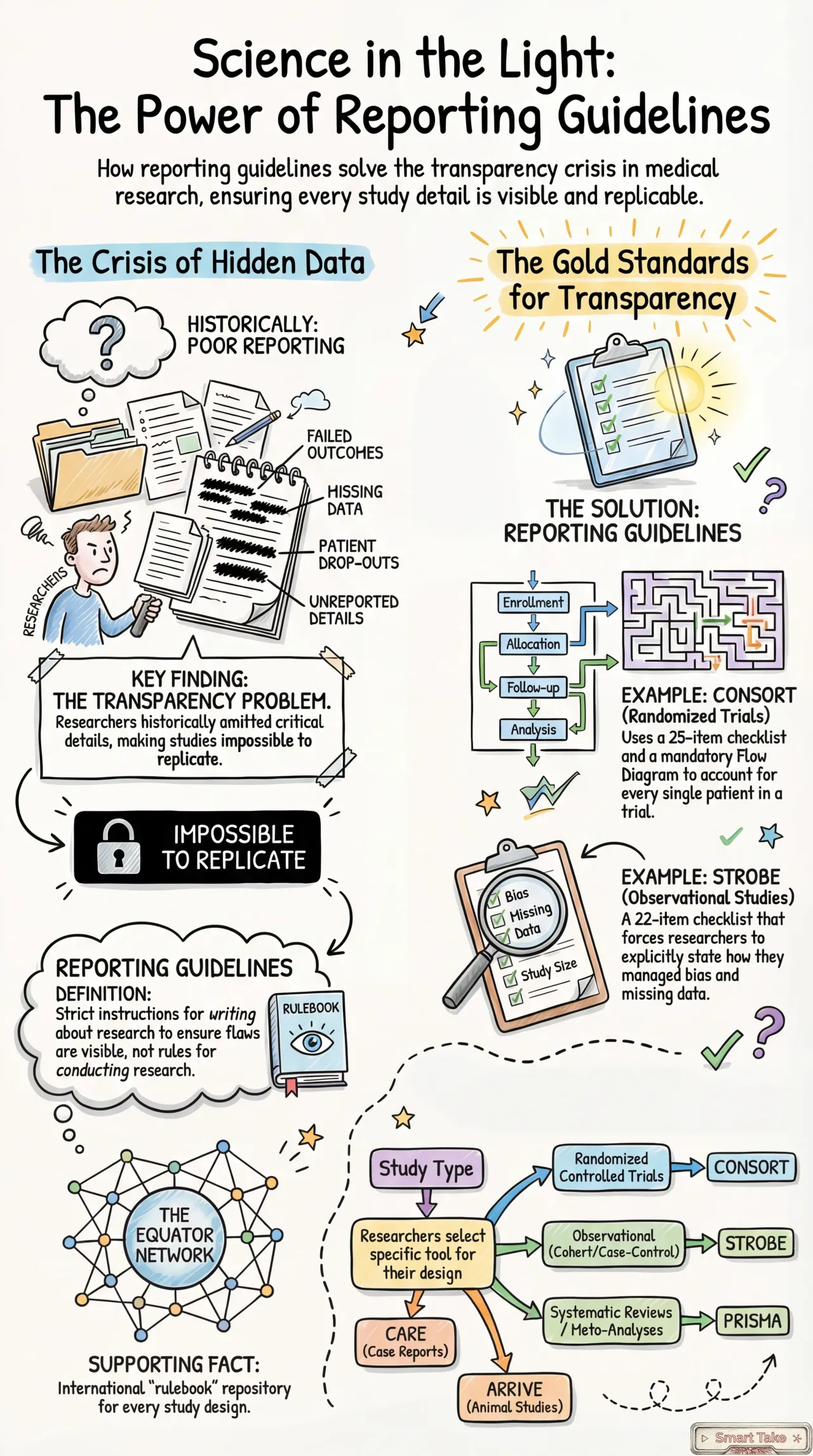
Reporting guidelines are essential standardized tools developed to address the crisis of poor transparency and selective reporting in medical research. They provide structured checklists and diagrams to ensure that researchers document every critical detail of their study design, execution, and analysis. By fostering accountability, these guidelines enable the scientific community to evaluate the validity of findings, facilitate study replication, and ensure that clinical decisions are based on trustworthy data. The EQUATOR Network serves as the global repository for these guidelines, which are now a mandatory requirement for publication in high-impact medical journals.
Key points
- Purpose: To enhance the quality, transparency, and reproducibility of health research reporting.
- EQUATOR Network: An international initiative acting as a central library for all reporting checklists (e.g., CONSORT, STROBE, PRISMA).
- CONSORT: The gold standard for Randomized Controlled Trials (RCTs), featuring a 25-item checklist and a mandatory participant flow diagram.
- STROBE: A 22-item checklist designed for observational studies (Cohort, Case-Control, and Cross-Sectional) to manage bias and confounding.
- Accountability: Guidelines ensure all participants are accounted for, including drop-outs and those lost to follow-up.
- Non-Prescriptive: These rules dictate how to report research, not necessarily how to conduct it.
1. The Reporting Crisis and Necessity
- Historical Issues: Incomplete reporting of randomization, exclusion of drop-outs, and 'cherry-picking' successful outcomes.
- Consequences: Inability to replicate studies and difficulty for clinicians to assess the trustworthiness of evidence.
- Solution: Reporting guidelines provide a framework for transparent disclosure of both strengths and flaws.
2. The EQUATOR Network
- Full Name: Enhancing the QUAlity and Transparency Of health Research.
- Role: A global repository providing specific checklists tailored to various study designs.
- Journal Requirements: Most high-quality journals require authors to submit a completed checklist alongside their manuscript.
3. CONSORT (Consolidated Standards of Reporting Trials)
- Primary Use: Randomized Controlled Trials (RCTs).
- The 25-Item Checklist:
- Focuses on design, analysis, and interpretation.
- Requires details on sample size determination.
- Explicitly asks for the randomization sequence generation and blinding methods.
- The Flow Diagram:
- Tracks participants from enrollment to analysis.
- Stages: Assessed for eligibility Randomized Follow-up Analyzed.
- Prevents the 'silent' removal of patients who dropped out.
4. STROBE (Strengthening the Reporting of Observational Studies in Epidemiology)
- Primary Use: Observational research including:
- Cohort Studies
- Case-Control Studies
- Cross-Sectional Studies
- The 22-Item Checklist:
- Addresses vulnerabilities specific to non-randomized studies (bias and confounding).
- Requires explicit statements on how missing data was handled.
- Forces authors to discuss the limitations of the study clearly.
5. Other Essential Guidelines
- PRISMA: Preferred Reporting Items for Systematic Reviews and Meta-Analyses.
- CARE: Specifically for Case Reports.
- ARRIVE: For Animal Research (Pre-clinical studies).
- COREQ: For Qualitative research (consolidated criteria for reporting qualitative research).
- STARD: For studies of Diagnostic Accuracy.