BCBR
Topic 09 · Qualitative research methods
Core principles of qualitative research
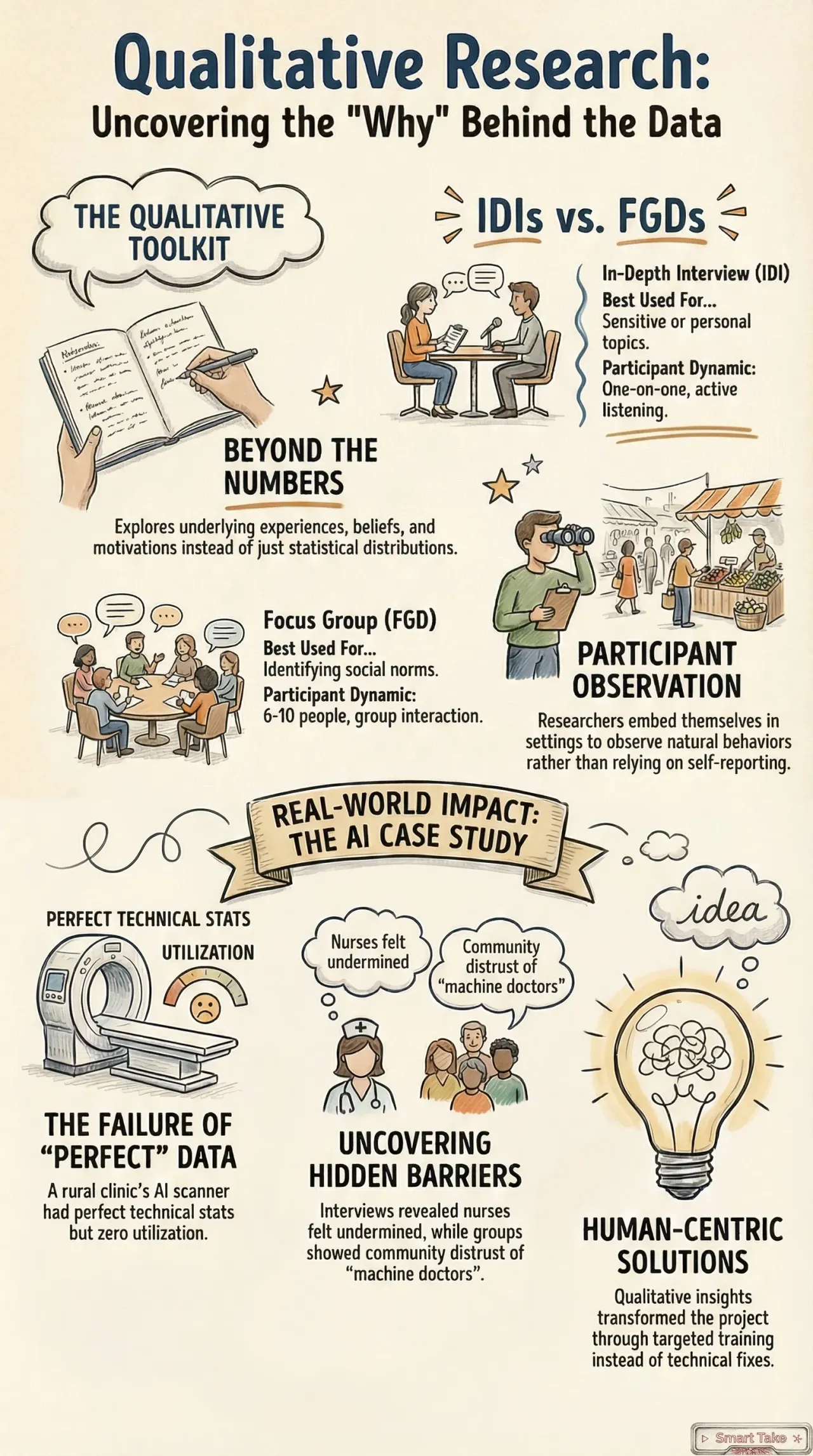
Qualitative research in the BCBR curriculum serves as a foundational methodology for exploring the 'why' and 'how' behind human behaviors, beliefs, and motivations, contrasting with the 'how many' focus of quantitative research. In the medical and public health context, it is indispensable for evaluating program efficacy, patient compliance, and ethical dilemmas. By utilizing tools such as In-Depth Interviews (IDIs), Focus Group Discussions (FGDs), and participant observation, researchers can uncover socio-cultural barriers and personal narratives that statistical data often overlooks, facilitating more effective, human-centric clinical interventions.
Key points
- Research Objective: Focuses on underlying experiences, motivations, and social norms rather than numerical distributions.
- In-Depth Interviews (IDIs): Best for sensitive, personal topics via one-on-one semi-structured conversations.
- Focus Group Discussions (FGDs): Utilizes group dynamics (6-10 people) to identify community consensus and social norms.
- Observational Methods: Includes participant observation to study natural behaviors in situ.
- Clinical Utility: Essential for understanding low utilization of medical technologies or poor adherence despite technical clinical success.
1. The Paradigm of Qualitative Research
- Quantitative vs. Qualitative:
- Quantitative: Focuses on relationships, distributions, incidence, and the question "How many?"
- Qualitative: Focuses on experiences, beliefs, and behaviors; addresses the questions "Why?" and "How?"
- Medical Significance: Vital for evaluating public health programs, understanding patient compliance, and navigating medical ethics.
2. In-Depth Interviews (IDIs)
- Format: One-on-one, semi-structured or unstructured conversation.
- Role of Researcher: Acts as an active listener using probing questions.
- Primary Purpose: Exploring extremely sensitive, personal, or deeply emotional topics.
- Utility: Drawing out individual narratives, belief systems, and personal medical histories where group settings might cause discomfort.
3. Focus Group Discussions (FGDs)
- Composition: 6 to 10 participants with similar backgrounds.
- Moderation: Led by an expert moderator who manages group dynamics and prevents dominant personalities from overshadowing others.
- Primary Purpose: Observing interactions, debates, and the formation of collective opinions.
- Utility: Identifying social norms, community consensus, and shared perceptions regarding health interventions.
4. Other Qualitative Methodologies
- Participant Observation:
- Researcher embeds within a community or hospital setting.
- Focuses on observing natural behaviors rather than self-reported data.
- Case Study:
- A comprehensive, in-depth examination of a single entity (group, community, or facility).
- Conducted over a prolonged period.
5. Clinical Application (Case Example)
- Scenario: High-accuracy AI diagnostic scanner with low utilization rates.
- Limitations of Quantitative Data: Shows technical perfection but fails to explain the lack of use.
- Qualitative Insights:
- IDIs with Nurses: Revealed feelings of professional undermining.
- FGDs with Patients: Revealed community distrust of "machine doctors."
- Outcome: These insights allow for the creation of human-centric training programs to overcome socio-cultural barriers.