BCBR
Probability sampling
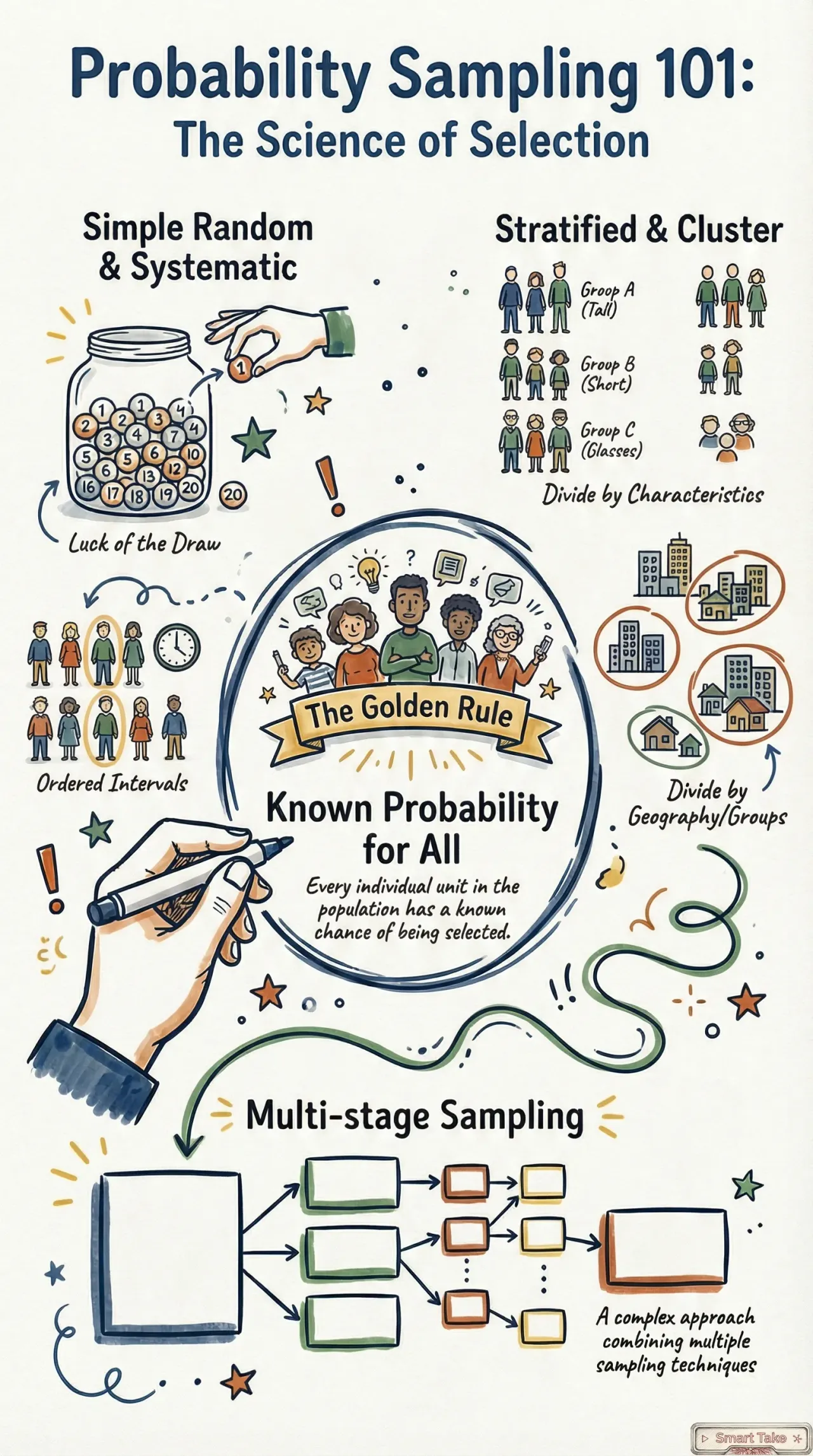
Probability sampling is a fundamental research methodology where every unit in a population has a known, non-zero chance of being selected. This approach is characterized by its ability to eliminate selection bias and provide a representative sample, allowing for the application of statistical theory to generalize findings to the target population. It is particularly essential for analytical studies seeking to establish causal relationships or associations. The primary advantage lies in the ability to measure sampling error through standard error, though the feasibility of specific techniques often depends on the availability of a comprehensive sampling frame and the geographical distribution of the population.
Key points
- Definition: Every individual in the population has a known probability of selection.
- Statistical Validity: Only sampling method that allows for statistical tests and generalization to the entire population.
- Bias Removal: Eliminates investigator/selection bias.
- Sampling Error: Can be quantitatively measured using standard error of mean or proportion.
- Core Techniques: Includes Simple Random, Systematic, Stratified, Cluster, and Multi-stage sampling.
- Requirement: Most methods (except Cluster/Multi-stage) require a complete sampling frame (list of all units).
1. Simple Random Sampling (SRS)
- Method: Most basic form; requires a complete sampling frame. Every unit is assigned a number, and selection is done via lottery or computer-generated random number tables.
- Advantages:
- Simple to understand and execute.
- Guarantees equal chance for all units.
- Sampling error is easily measured.
- Disadvantages:
- Practically impossible for large populations without a complete list.
- May not always yield a perfectly representative sample of diverse sub-groups.
2. Systematic Sampling
- Method: Uses a sampling interval (Total population / Sample size). A starting point is randomly picked , then every unit is selected.
- Advantages:
- Ensures even spread across the list.
- Easy to implement in field work (e.g., every 10th house).
- Disadvantages:
- High risk of bias if the population list contains a hidden periodic pattern or cycle.
- Statistical formulas are complex and often require approximations.
3. Stratified Sampling
- Method: Population is divided into homogeneous subgroups called 'strata' (e.g., age, gender). A simple random sample is then taken from each stratum.
- Advantages:
- Guarantees representation of all subgroups.
- High precision if variables are associated with strata.
- Allows separate conclusions for each subgroup.
- Disadvantages:
- Difficult to measure overall sampling error.
- Potential loss of precision if there are too many strata with very small samples.
4. Cluster Sampling
- Method: Used for large, scattered populations where no sampling frame exists. Population is divided into 'clusters' (wards, streets). A random sample of clusters is chosen; then all or some units within those clusters are surveyed.
- Assumption: Minimal variability between clusters; variability within a cluster mirrors the general population.
- Advantages:
- Bypasses the need for a full population list.
- Economical (less travel, time, and resources).
- Disadvantages:
- High 'design effect' (errors) if units within clusters are too similar (homogeneous).
- Complex calculation of sampling error.
5. Multi-stage Sampling
- Method: Combines multiple sampling methods in successive stages (e.g., Stage 1: SRS for states; Stage 2: Systematic for districts; Stage 3: Cluster for households).
- Advantages:
- Most feasible approach for massive geographical areas (e.g., national surveys).
- No requirement for an initial comprehensive population list.
- Disadvantages:
- Calculating sampling error is extremely difficult due to multiple sampling units and stages.