BCBR
Non-probability sampling
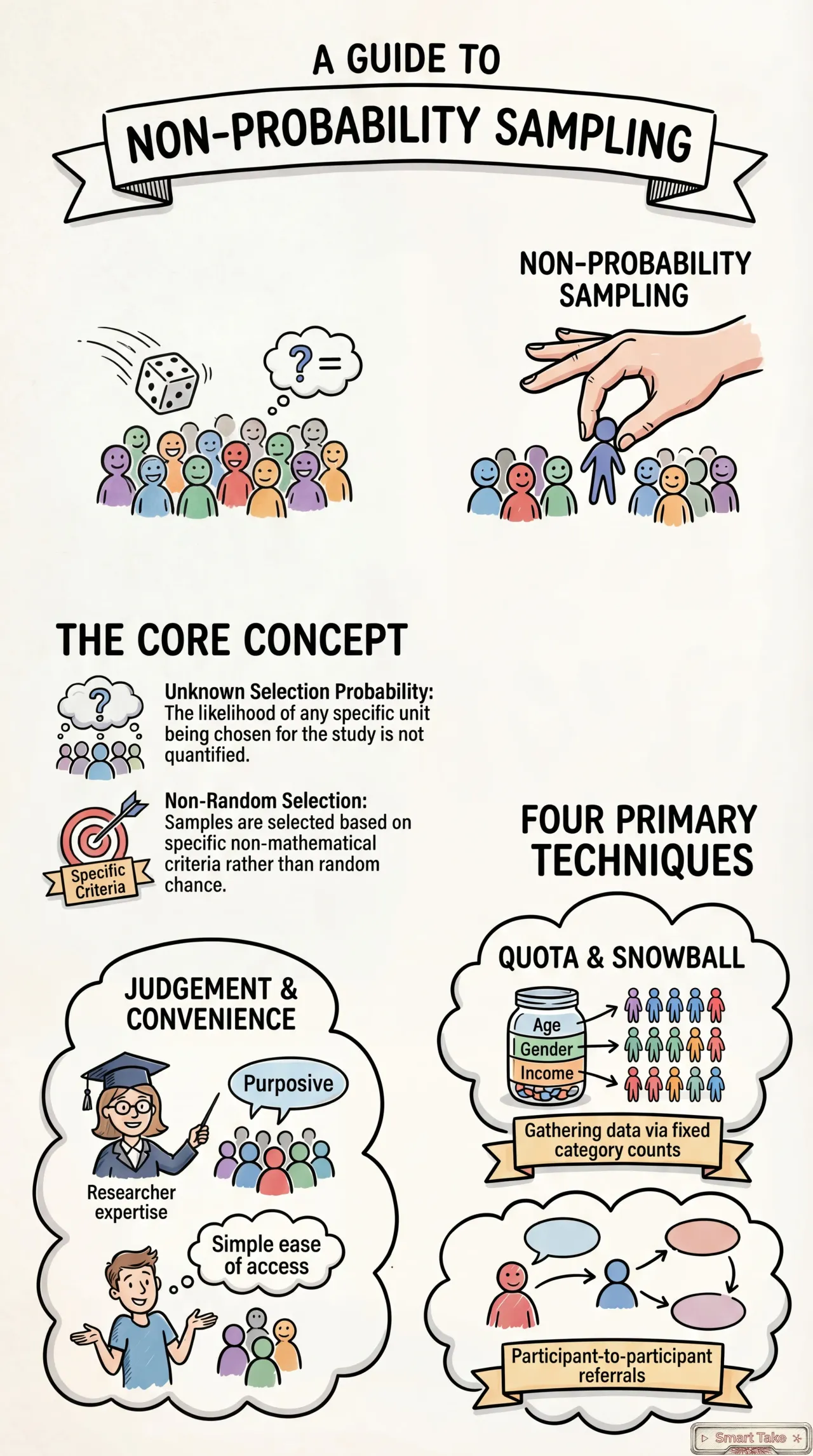
Non-probability sampling is a category of sampling where the probability of selecting any specific unit from the population is unknown due to the absence of objective randomization. While these methods are prone to significant selection bias and sampling error, they are valuable in medical research for hypothesis generation, pilot studies, and researching rare conditions where a complete sampling frame is unavailable. However, the lack of representativeness means results cannot be statistically generalized to the overall population.
Key points
- No Randomization: Selection is based on subjective criteria rather than random chance.
- Selection Bias: High risk of bias as the researcher influences who enters the study.
- Low External Validity: Findings cannot be accurately generalized to the target population.
- Hypothesis Generation: Primarily used for exploratory research rather than confirming causal associations.
- Four Main Types: Includes Judgment (Purposive), Convenience, Quota, and Snowball sampling.
1. Definition and Core Characteristics
- In non-probability sampling, the chance of any unit being included is unknown.
- Disadvantages:
- High potential for sampling error.
- Significant selection bias due to subjective involvement.
- Results lack generalizability (low external validity).
- Usage: Best suited for preliminary research, generating hypotheses, and when systematic probability sampling is not feasible.
2. Types of Non-Probability Sampling
A. Judgement (Purposive) Sampling
- Method: The investigator handpicks subjects based on their own subjective professional judgment of who is "appropriate."
- Example: Choosing 8 specific students from a class of 20 because the researcher deems them the best fit for the study.
- Disadvantage: Entirely dependent on the researcher's perspective; if the judgment is flawed, the data is invalid.
B. Convenience Sampling
- Method: Subjects are selected based on ease of access or proximity to the researcher.
- Example: Interviewing people in the nearest geographical location or selecting the children standing closest to the investigator.
- Disadvantage: Massive risk of bias; often captures "best-case" or "worst-case" scenarios rather than a representative average.
C. Quota Sampling
- Method: The population is divided into categories (quotas) based on the researcher's judgment. The researcher then fills these quotas using non-random methods.
- Example: Deciding a survey of 500 people must include 60% housewives, 25% farmers, and 15% children based on an arbitrary decision.
- Disadvantage: No scientific or statistical basis for the quota proportions; results remain highly biased.
D. Snowball Sampling
- Method: A chain-referral technique. The researcher identifies an initial subject with a specific trait and asks them to refer others with the same trait.
- Process: Subject A identifies Subject B identifies Subject C. The sample "rolls" and grows like a snowball.
- Usage: Essential for studying rare diseases or hard-to-reach populations where no registry exists.
- Disadvantage: Limited by the social network of the initial participants.