BCBR
Topic 08 · Validity of epidemiological studies
Selection bias and information bias
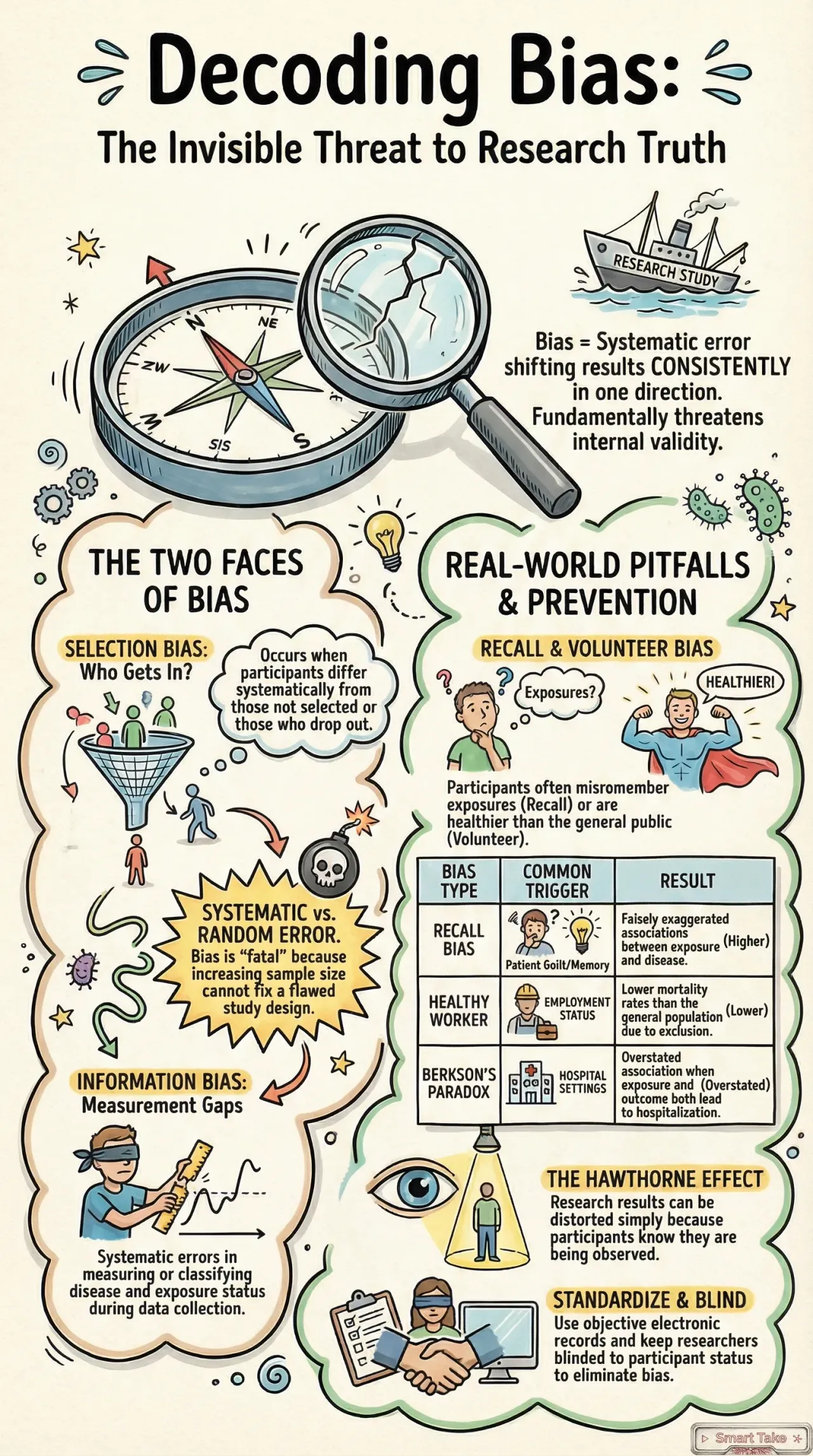
Internal validity in epidemiological research is the degree to which study results accurately reflect the true situation in the target population. Systematic error, or bias, is the primary threat to internal validity and occurs during the design, execution, or data collection phases. Unlike random error, bias cannot be corrected by increasing sample size or through post-hoc statistical analysis. The two main categories of bias are selection bias, which pertains to how participants are enrolled or retained, and information bias, which involves errors in measurement or classification of exposure and outcome. Proper study design, objective measurement, and blinding are essential to minimizing these threats.
Key points
- Bias is a systematic error that leads to an incorrect estimate of association and threatens internal validity.
- Selection bias arises from systematic differences between those selected for a study and those who are not.
- Information (measurement) bias occurs during data collection due to errors in classifying disease or exposure status.
- Key types of selection bias include Berkson's Paradox, Healthy Worker Effect, and Non-response bias.
- Key types of information bias include Recall bias, Interviewer bias, and the Hawthorne Effect.
- Strategies to prevent bias include strict inclusion/exclusion criteria, randomization, blinding, and using objective data sources.
-
Internal Validity and Bias
- Internal Validity: The extent to which results represent the truth within the study population.
- Bias (Systematic Error): A consistent shift of results in one direction. It occurs in design, execution, or data collection.
- Difference from Random Error: Random error can be reduced by increasing sample size; bias cannot. Bias cannot be fixed by statistical analysis after data collection.
-
Selection Bias
- Definition: Systematic difference between participants and non-participants, or those who drop out (attrition).
- Volunteer/Self-Selection Bias: Volunteers are often healthier or more motivated than the general population.
- Non-Response Bias: Occurs when dropouts have significantly different characteristics than those who remain.
- Berkson's Paradox: Seen in hospital-based case-control studies; both exposure and outcome increase the probability of hospitalization.
- Healthy Worker Effect: Employed populations have lower mortality because the severely ill/disabled are excluded from the workforce.
-
Information (Measurement) Bias
- Definition: Systematic error in measuring or classifying disease/exposure status.
- Recall Bias: Common in case-control studies; cases remember past exposures more meticulously than healthy controls.
- Interviewer Bias: Investigators probe more aggressively for exposure in 'cases' than in 'controls'.
- Hawthorne Effect: Participants change their behavior simply because they are being observed.
-
Prevention Strategies
- To Eliminate Selection Bias:
- Clearly define inclusion and exclusion criteria.
- Ensure high response/participation rates.
- Utilize randomization in experimental trials.
- To Eliminate Information Bias:
- Use objective measurement tools (e.g., Electronic Health Records) instead of memory-based recall.
- Implement blinding for both participants and interviewers.
- Standardize all data collection techniques and protocols.
- To Eliminate Selection Bias: