BCBR
Topic 08 · Validity of epidemiological studies
Confounding and how to control it
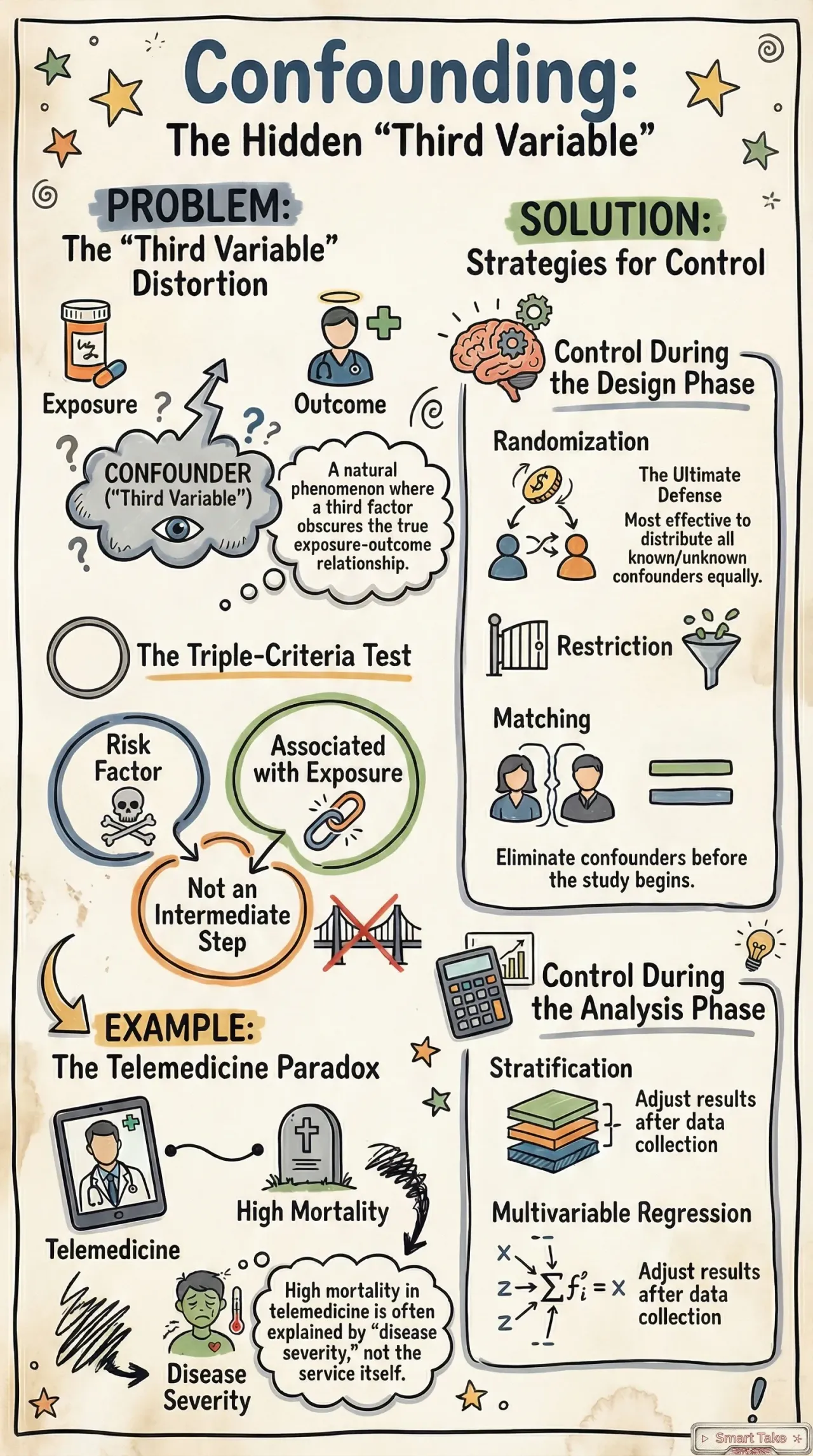
Confounding in biomedical research occurs when the true association between an exposure and an outcome is distorted by a third variable, known as a confounder. Unlike researcher-driven bias, confounding is a natural phenomenon inherent in observational data due to complex interrelations between biology and environment. To be a confounder, a variable must be an independent risk factor for the disease, be associated with the exposure, and not be an intermediate step in the causal pathway. Effective management of confounding is required during both the study design phase (Randomization, Restriction, Matching) and the analysis phase (Stratification, Multivariable Regression) to ensure internal validity.
Key points
- Definition: Distortion of the exposure-outcome relationship by a third factor.
- Nature: It is a natural phenomenon in observational studies, not a researcher error (bias).
- Three Essential Criteria: Must be a risk factor for the outcome, associated with the exposure, and not an intermediate step in the causal chain.
- Design Phase Control: Includes Randomization (gold standard), Restriction (limiting study population), and Matching.
- Analysis Phase Control: Includes Stratification (subgroup analysis) and Multivariable Regression (statistical adjustment).
- Reversibility: Unlike bias, confounding can be adjusted for mathematically after data collection.
1. The Nature of Confounding
- It represents a 'mixing of effects' where the effect of the exposure is confused with the effect of the confounder.
- Difference from Bias: Confounding is a property of the study population and biology; Bias is a systematic error in study design or execution.
2. The Three Criteria for a Confounder
To identify a variable as a confounder, it must meet all three:
- Condition 1: It must be an independent risk factor for the disease/outcome (even in the absence of the exposure).
- Condition 2: It must be associated with the exposure in the population under study.
- Condition 3: It must NOT be an intermediate step in the biological pathway between exposure and disease.
- Note: If a variable is in the causal chain, controlling for it will mathematically erase the real effect of the exposure.
3. Methods to Control Confounding (Design Phase)
These methods are implemented before data collection begins:
- Randomization:
- Used in experimental studies (RCTs).
- Ensures both known and unknown confounders are distributed equally across groups.
- Restriction:
- Limiting the study to individuals who fall within a specific category of the confounder (e.g., studying only non-smokers to eliminate smoking as a confounder).
- Drawback: Reduces the generalizability of the study.
- Matching:
- Commonly used in Case-Control studies.
- Selecting controls that are identical to cases regarding specific confounding variables (e.g., age, sex, or smoking status).
4. Methods to Control Confounding (Analysis Phase)
These methods are used to 'fix' or adjust for confounding after data is collected:
- Stratification:
- Evaluating the association within subgroups (strata) of the confounder.
- Example: Analyzing the data separately for men and women to see if the outcome holds true in both groups.
- Multivariable Regression Analysis:
- Utilizing statistical models to adjust for multiple confounders simultaneously.
- Allows researchers to calculate an 'Adjusted' Odds Ratio or Relative Risk, representing the independent effect of the exposure.