BCBR
Topic 14 · Study plan and project management
Foundations of research planning and study design
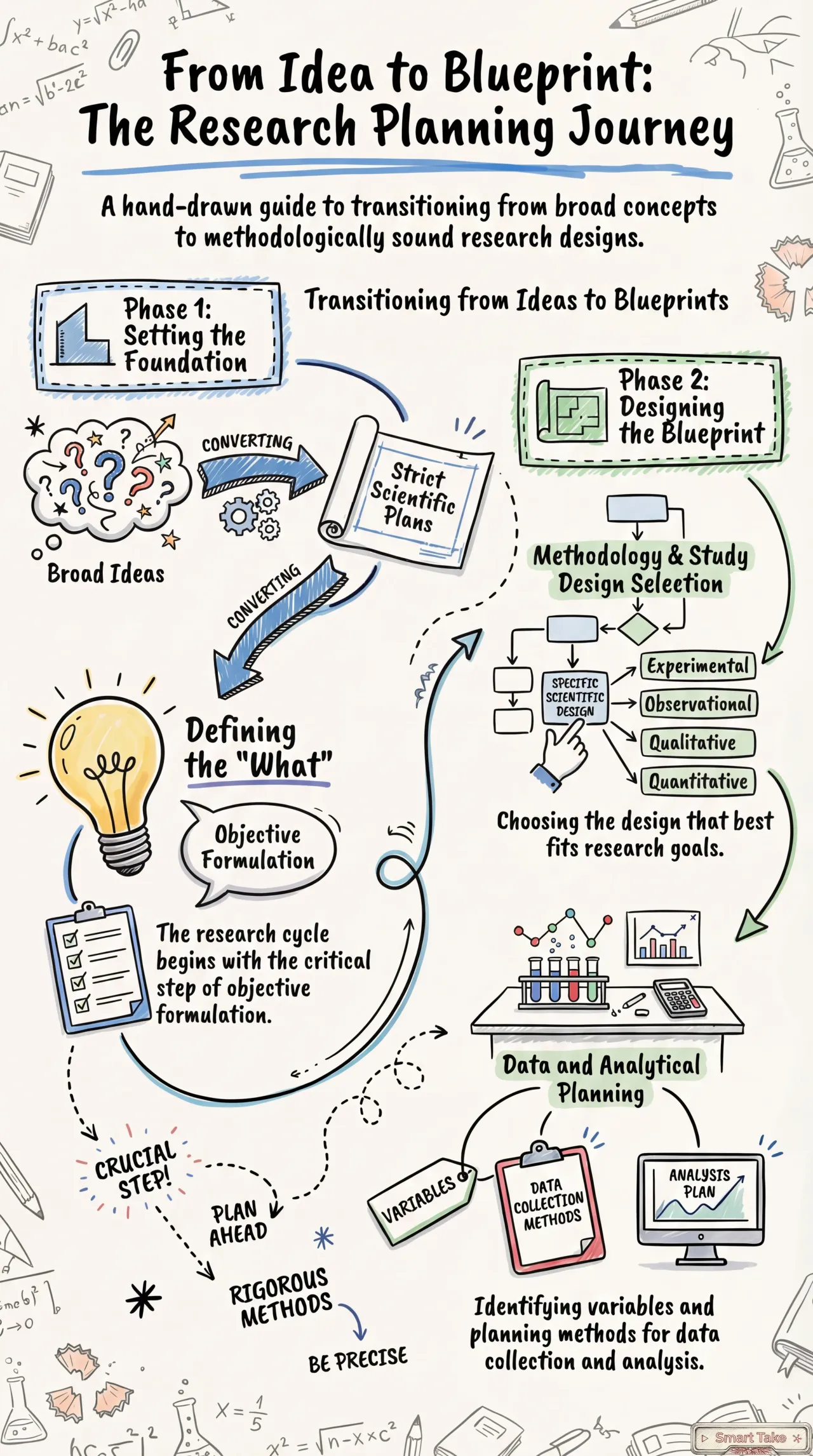
Foundations of Research Planning and Study Design focuses on the transition from a conceptual research idea to a rigorous, methodologically sound scientific blueprint. The process is compared to architectural planning, emphasizing that robust preparation, including securing approvals and funding, is essential before data collection begins. The primary goal of research is to produce definitive endpoints that inform policy-making and public health programs, moving beyond the simple 'publish or perish' academic paradigm. A systematic approach is required to avoid the dangers of ad hoc planning, which leads to clinical confusion, unanalyzable data, and wasted resources. Effective research planning involves a cyclical process of identifying gaps through literature review, formulating SMART objectives, selecting appropriate study designs based on disease frequency and latency, and pre-planning data analysis through dummy tables and standardized operational definitions.
Key points
- Research Architecture: Research requires a strict blueprint (protocol) to ensure findings are valid and useful for public health.
- The Research Cycle: Begins with a literature review to identify gaps, leading to the formulation of specific, measurable questions.
- Objective Hierarchy: Studies should have one primary objective (used for sample size calculation) and limited secondary objectives.
- SMART Criteria: Objectives must be Specific, Measurable, Achievable, Relevant, and Time-bound.
- Study Design Selection: Choice depends on whether the condition is acute vs. chronic and rare vs. frequent.
- Operational Definitions: Variables must be strictly defined and standardized to ensure consistency in measurement.
- Confounder Management: Identifying variables like age and gender early is crucial for statistical adjustment during analysis.
- Pre-analytical Planning: Creating dummy tables (2x2) before data collection ensures all necessary data is captured and prevents 'data dredging.'
I. Introduction to Research Planning
- The Architectural Analogy: Like building a house, research requires drafting blueprints, obtaining ethical/administrative approvals, and securing funding before 'digging the foundation' (data collection).
- Ultimate Goals:
- Generating evidence for policy-making and programmatic absorption.
- Fulfilling academic requirements (Publish or Perish).
- Risks of Ad Hoc (Informal) Planning:
- Clinical confusion and unclear objectives.
- Collection of unanalyzable or irrelevant data.
- Wastage of time, money, and participant effort.
II. The Research Cycle and Objective Formulation
- Identifying Gaps: Use exhaustive literature reviews to move from a broad idea to a specific research question.
- Primary vs. Secondary Objectives:
- Primary Objective: The main question the study is designed to answer; it is the sole metric for calculating the sample size.
- Secondary Objectives: Additional data points gathered; should be kept to a minimum to maintain focus.
- SMART Criteria for Objectives:
- Specific: Use operational definitions.
- Measurable: Use quantifiable criteria.
- Achievable: Feasible within constraints.
- Relevant: Addresses the identified gap.
- Time-bound: Defined period for completion.
- Nature of Research: Can be Exploratory (identifying potential causes) or Confirmatory/Estimating (measuring precise prevalence/effect).
III. Methodology and Study Design Selection
- Descriptive Studies:
- Acute conditions (e.g., Pneumonia): Cohort or Surveillance studies to measure Incidence.
- Chronic conditions: Cross-sectional or Cohort studies to establish Prevalence.
- Analytical (Comparative) Studies:
- Rare diseases / Long latency: Retrospective Case-control studies (Yields Odds Ratios).
- Frequent conditions / Short latency: Prospective Cohort or Analytical Cross-sectional (Yields Relative Risk, Odds Ratios, or Prevalence Ratios).
IV. Data Collection and Analytical Planning
- Operational Definitions & Standardization: Defining variables strictly (e.g., exact hemoglobin cutoffs for anemia) to ensure reproducibility.
- Example (Iodine deficiency): Physical exam (Goiter) for chronic status; Urine tests for current exposure; Salt spot tests for dietary access.
- Confounders: Variables (like age/gender) that influence both exposure and outcome must be identified a priori for later statistical adjustment.
- Dummy Tables: Creating 2x2 tables prior to data collection to:
- Verify instrument design.
- Prevent unnecessary or missing comparisons.
- Expedite the final publication process.
- Sample Size: Must be calculated a priori in consultation with a statistician to ensure the study has sufficient power and generalizability.