BCBR
Topic 14 · Study plan and project management
Project management and execution
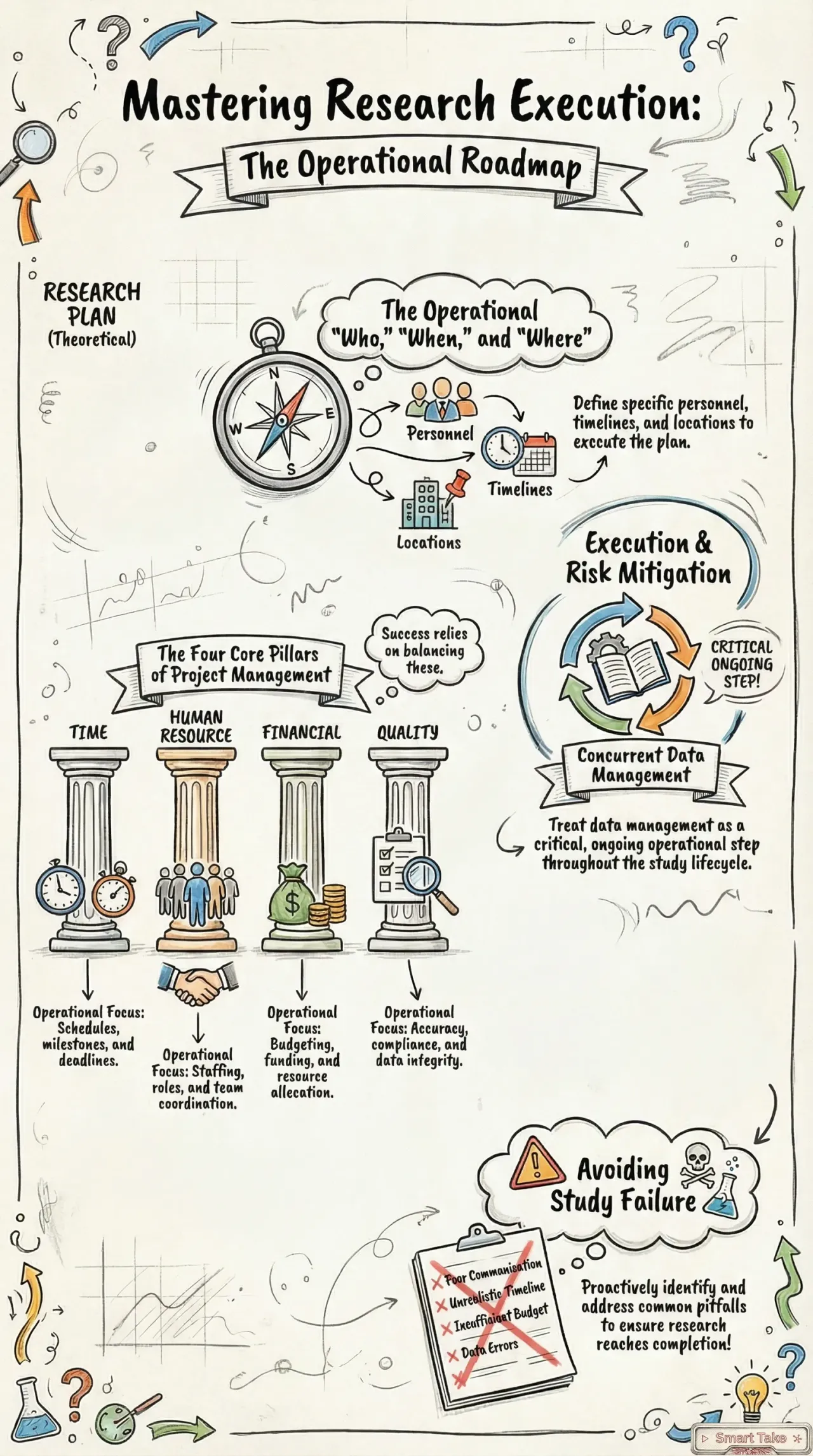
This module outlines the operational framework essential for transitioning a scientific research plan from paper to real-world execution. Project management in biomedical research ensures that deliverables are met through the synchronized management of time, human resources, finances, and quality. A central theme is the necessity of concurrent data management to allow for mid-course corrections. The successful completion of a study depends not only on sound epidemiological design but also on rigorous operational oversight to prevent common pitfalls such as unrealistic timelines, incompetent staffing, and poor monitoring.
Key points
- Project Management Definition: The continuous, coordinated operation required to meet study goals within defined time, budget, and quality constraints.
- The Four Pillars: Time, Human Resources, Finance, and Quality Management.
- Time Tracking: Tools like Gantt charts are indispensable for mapping the research trajectory from concept to publication.
- Team Dynamics: Research is a "team sport" requiring motivated staff, constant supervision, and effective stakeholder communication.
- Financial Continuity: Grant disbursements depend on meeting pre-defined targets; meticulous long-term planning is mandatory.
- Concurrent Data Management: Data must be checked during collection, not after, to identify faults and rectify errors immediately.
- Preventing Failure: Most studies fail due to 'bad science' (non-SMART objectives), unrealistic timing, poor personnel management, or lack of PI oversight.
I. Introduction to Project Management
- Transition: Moving from theoretical scientific planning to field or clinical execution.
- Objective: Ensuring deliverables (results/publications) are achieved while balancing time, budget, and quality standards.
II. The Four Core Pillars of Project Management
1. Time Management
- Tools: Utilization of Gantt charts to visualize the project lifecycle.
- Stages of Mapping:
- Concept paper development.
- IRB/Ethics committee approval.
- Data collection phase.
- Data analysis.
- Final publication.
- Role of PI: The Principal Investigator must ensure strict adherence to these scheduled milestones.
2. Human Resource (HR) Management
- Philosophy: Research cannot be done in isolation; it requires a collaborative team.
- Core Requirements:
- Careful selection of personnel.
- High levels of motivation.
- Extensive and ongoing training.
- Adequate and constant supervision.
- Operational Actions:
- Swift replacement of underperforming or incompetent staff.
- Frequent team meetings to maintain alignment.
- Robust communication with Institutional Ethics Committees (IEC) and stakeholders.
3. Financial Management
- Planning: Requires meticulous, long-term budgeting.
- Disbursements: Continuous release of grant funds is usually contingent upon meeting specific project targets.
4. Quality Management
- Scope: Maintaining high standards across:
- Clinical procedures.
- Laboratory assays.
- Data collection methodologies.
- Regular supervisory field/site visits.
III. Concurrent Data Management
- The Gold Rule: Data must be managed and audited concurrently with collection.
- Advantages: Allows for rapid identification of systematic errors and enables immediate mid-course corrections.
- The Risk of "Piling Up": Delaying data review until the end of the project leads to unfixable errors and total project failure.
IV. Common Pitfalls and Study Failure
- Bad Science: Poorly defined research questions and objectives that are not SMART (Specific, Measurable, Achievable, Relevant, Time-bound).
- Bad Timing: Setting unrealistic scales -- either too short for meaningful data or too long for sustained funding.
- Bad Personnel: Staff who are incompetent, unmotivated, or lack clear direction.
- Bad Oversight: Failure of the PI to monitor progress concurrently or enact necessary corrections.
V. Conclusion
- Success is a combination of Epidemiological Design (scientific validity) and Operational Management (execution). This synergy ensures internal and external validity, leading to high-impact scientific advancement.